

Let me introduce you to Fern.
Fern is my cat. She is small, quiet, and, as far as I can tell, running a long-term behavioral experiment on me.
Every morning, she meows near the kitchen. I feed her. That part makes sense, right?
What’s more interesting is what happens at 2:17 p.m. on a random Tuesday.
She meows again.
I tell myself, “She just ate.”
She continues.
Eventually, I stand up, go to the kitchen, and open a fresh can of cat food.
Somewhere along the way, this stopped being about hunger… It became about learning.
In a previous article, Fern helped us understand classical conditioning, which is how associations form between events. But what’s happening here is different. This isn’t about linking two stimuli.
This is about behavior being shaped by consequences.
Specifically, it’s about what’s called operant conditioning, and it’s one of the most powerful ideas in psychology.
A Rat, a Lever, and a Radical Idea
Operant conditioning is most closely associated with psychologist B.F. Skinner.
Skinner believed that to truly understand behavior, we needed to examine not just what comes before it, but what comes after it.
So he designed controlled environments, later called “Skinner boxes”, where animals could perform simple actions like pressing a lever or pecking a disk and experience consequences.
When a rat pressed a lever, food might appear.
Press the lever again. More food!
Soon, the rat pressed the lever frequently. One might imagine it like UberEats for rodents… as far as the rat was concerned, anyway.
Skinner observed something straightforward but revolutionary: behavior is shaped and maintained by its consequences.
So, if a behavior is followed by something beneficial, it tends to increase.
Likewise, if it is followed by something unpleasant, it tends to decrease.
Makes sense, right?
This shifted psychology’s focus from internal speculation to observable patterns. Instead of asking, “What is the animal thinking?” Skinner asked, “What consequences are strengthening this behavior?”
And, as it just so happens, that framework turned out to apply remarkably well to humans, too!
The Core Principle: Consequences Control Behavior
Operant conditioning can be summarized fairly simply:
Behaviors that are reinforced become more likely.
Behaviors that are punished become less likely.
But to really understand this, we need to clarify two words that people constantly misuse: reinforcement and punishment.
In psychology, these words do not necessarily mean “good” and “bad.”
They mean:
- Reinforcement = increases a behavior
- Punishment = decreases a behavior
That’s it.
If the behavior increases, reinforcement happened.
If it decreases, punishment happened.
Whether something feels “nice” or “mean” is secondary. The only thing that matters here is the effect on behavior.
The Four Ways Consequences Shape Us
With that distinction in mind, there are two dimensions at work in operant conditioning:
- Are we adding something or removing something?
- Is the behavior increasing or decreasing?
As such, this then creates four possibilities.
Positive Reinforcement (Add Something and Behavior Increases)
This is one of the most powerful tools for shaping behavior, and it tends to be what people immediately think of when they think of operant conditioning.
With positive reinforcement, you add a desirable stimulus, and the behavior becomes more likely.
So, looking at a few examples:
- A dog sits on command + receives a treat = sitting on command increases.
- An employee performs well + gets a bonus = performance increases.
- You post a photo on Instagram + receive likes = posting increases.
Here, “positive” means adding something. It does not necessarily mean morally good, healthy, or beneficial. In fact, positive reinforcement can strengthen behaviors that are harmful or socially undesirable!
Consider, for example:
- Child throws a tantrum in a store + parent gives candy to stop it = tantrums increase.
- Someone makes a cruel joke + the group laughs = cruel humor increases.
- A person spreads gossip + receives attention and intrigue = gossiping increases.
- An aggressive driver cuts someone off + arrives slightly sooner = aggressive driving increases.
In each of those cases, something is being added (candy, laughter, attention, time saved) and the behavior is being strengthened.
Reinforcement doesn’t even slightly care about ethics. What it cares about is repetition.
So, if a behavior consistently produces something rewarding (yes, even socially toxic rewards), it tends to grow.
Negative Reinforcement (Remove Something and Behavior Increases)
Now let’s look at the flip side. With negative reinforcement, a behavior removes or reduces something unpleasant, and the behavior becomes more likely in the future.
Negative reinforcement often gets misunderstood as punishment. It is not punishment because, going back to the terms we covered a bit ago, it increases behavior.
Some everyday examples:
- Buckle your seatbelt + that beeping stops = seatbelt use increases.
- Take an aspirin + headache fades = aspirin use increases.
- Submit your assignment + anxiety decreases = submitting on time increases.
The key idea here is that relief can be incredibly reinforcing.
Don’t believe me? Just look at nearly any advertisement!
Ads built on negative reinforcement rarely say, “Add joy to your life.”
Instead, they say things like:
- “Tired of back pain?”
- “Say goodbye to stubborn stains!”
- “Stop worrying about wrinkles.”
- “Never deal with bad breath again!”
- “End those sleepless nights.”
Notice the structure?
First, they’re highlighting an irritation, fear, insecurity, or discomfort and then they’re presenting a product that promises removal!
- Buy this = anxiety decreases.
- Use this = embarrassment disappears.
- Install this = stress goes away.
When relief follows a purchase, that purchase behavior becomes more likely in the future!
Negative reinforcement is everywhere because discomfort is everywhere, and we humans are very, seriously, deeply, and truly motivated to escape it.
Positive Punishment (Add Something and Behavior Decreases)
Positive punishment occurs when something unpleasant is added after a behavior, decreasing the likelihood of that behavior in the future.
Take, for example:
- You get caught speeding + receive a ticket = speeding decreases.
- You touch a hot stove + feel pain = touching decreases.
- A student disrupts class + receives detention = disruption decreases.
Easy, right? But here’s where it gets more nuanced…
Punishment doesn’t teach what TO DO. It only signals what NOT to do.
So, if a child is yelled at for drawing on the wall, they may stop drawing on the wall. However, they haven’t necessarily learned where drawing is appropriate.
Punishment can also produce side effects like fear, avoidance, resentment, secrecy, or even aggression.
This could look like:
- An employee gets harshly criticized in meetings and stops speaking up. It’s not because their ideas improved, but because they’ve learned that silence avoids discomfort.
- A teenager gets punished severely for minor mistakes and ends up becoming better at hiding behavior rather than changing it.
Positive punishment can suppress behavior pretty quickly. However, without reinforcement of alternative behaviors, it very rarely builds something better in its place.
Negative Punishment (Remove Something and Behavior Decreases)
Negative punishment occurs when something desirable is removed after a behavior, decreasing its frequency.
Some everday examples:
- Teen breaks curfew = loses car privileges.
- Child hits their sibling = loses screen time.
- Athlete violates team rules = sits out of the game.
Again, “negative” in this context means “removal,” not cruelty. If the behavior goes down, punishment occurs regardless of your intention.
But negative punishment also has complexity…
The effectiveness here depends on whether the removed stimulus is actually valued. If a teenager doesn’t care about football, telling them that they can’t go to the game on Friday night won’t reduce their behavior.
Also, like positive punishment, negative punishment can produce some unintended outcomes as well. It could lead to withdrawal, emotional distance, attempts to regain control, or a focus on fairness rather than growth.
When used thoughtfully, negative punishment can establish boundaries. But when it’s used carelessly, it can erode trust.
Operant conditioning describes what happens to behavior, but it doesn’t tell us automatically how to apply it ethically. That part requires careful judgment.
Fern, Revisited: A Behavioral Loop
Seizing yet another golden opportunity to talk about my cat, let’s analyze my household honestly.
Fern meows.
I give her food.
The meowing increases in frequency and confidence.
From Fern’s perspective:
- Behavior: Meowing
- Consequence: Food appears
- Result: Meowing increases
That’s positive reinforcement.
Now, from my perspective:
Fern meows.
The sound is persistent. It drills gently but firmly into my conscience.
I feed her.
The meowing stops.
From my perspective:
- Behavior: Feeding the cat
- Consequence: Noise disappears
- Result: Feeding behavior increases
That’s negative reinforcement.
She is reinforced by the food. I am reinforced by the silence.
Operant conditioning often works in loops like this, where two organisms shape each other’s behavior through consequences.
This is not manipulation so much as it is learning.
Why Operant Conditioning Explains So Much of Modern Life
Operant conditioning is not confined to labs or pet training manuals.
As you likely noticed when we were looking at the examples of positive and negative reinforcement/punishment, it is embedded in modern systems and our everyday lives.
In fact, once you start specifically looking for those reinforcement and punishment patterns, modern life begins to look way less random and a lot more engineered!
Habits: The Architecture of Repetition
Habits don’t form because we declare them noble. They form because they are reinforced!
Let’s say you go for a run. Afterward, you feel accomplished and clear-headed. You look in the mirror and smile as you feel maybe slightly superior to yesterday’s version of yourself.
That feeling is reinforcement.
You cook at home.
You save money and feel competent.
Boom. Reinforcement.
You check your phone while working.
For a moment, boredom disappears.
Yup! Reinforcement.
Here’s the uncomfortable truth: many “bad” habits persist not because we lack discipline, but because they are consistently reinforced in small, immediate ways.
- Snacking reduces boredom.
- Complaining produces sympathy.
- Avoiding a task reduces anxiety (temporarily).
- Procrastinating replaces dread with relief.
Long-term consequences (weight gain, missed deadlines, stress) are often delayed and abstract.
Operant conditioning is biased toward the immediate. That means that if we want better habits, we often don’t need more motivation. What we really need are better reinforcement structures!
Addiction: When Reinforcement Hijacks the System
Addiction is operant conditioning with the volume turned all the way up.
Substances and certain behaviors (gambling, gaming, pornography, even social validation) can produce powerful reinforcement through feelings of euphoria, escape, relief, or numbness.
If a behavior reliably produces intense reward or intense relief, it will be repeated.
Over time, the brain learns: Behavior = Powerful consequence.
Even when the long-term costs become severe (health issues, relationship strain, financial damage, etc.), the short-term reinforcement can still dominate decision-making.
Operant conditioning helps explain why “just stop” is rarely effective advice. (Like “Wow! I didn’t consider “just stopping” before! Thanks, Captain Obvious!”)
If a behavior is being strongly reinforced, removing it without replacing the reinforcement leaves a vacuum.
Treatment often works not by simply punishing the behavior, but by:
- Reducing access to reinforcement
- Increasing costs
- Introducing alternative sources of reinforcement
- Breaking environmental cues linked to the behavior
Addiction isn’t a moral failure, as it often gets treated. In practice (and in a nutshell), it’s a reinforcement loop that has become deeply entrenched.
Social Media: The Variable Reward Machine
Now let’s talk about the device in your pocket.
You open an app.
Sometimes nothing happens.
Sometimes you get a comment.
Sometimes 3 likes.
Sometimes 47.
Sometimes someone you care about responds.
That unpredictability is not accidental.
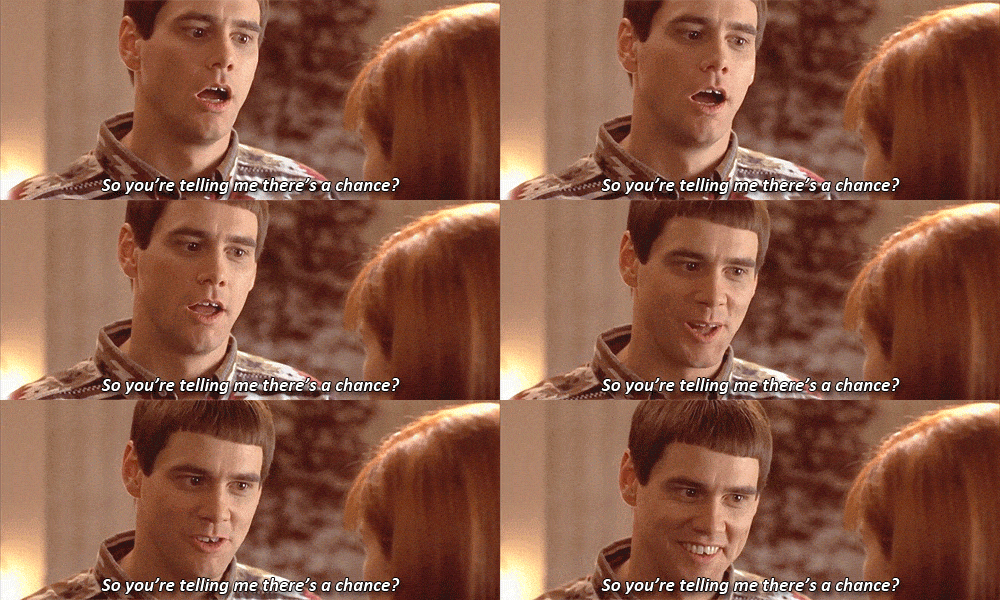
It’s actually what’s called a variable ratio reinforcement schedule, where rewards are delivered after an unpredictable number of responses.
(This is the same schedule that makes slot machines so compelling, by the way!)
When reinforcement is unpredictable, behavior becomes:
- More persistent
- More resistant to extinction
- Harder to stop
If every one of your posts received exactly 12 likes, your behavior would stabilize. Whether it’s a picture of your breakfast tacos, your vacation to Switzerland, a political gripe, or your wedding day… you get 12 likes.
But because sometimes you hit a “jackpot” of attention, your brain just loves to keep pulling the lever.
Scroll.
Refresh.
Check again.
The behavior persists not because every interaction is rewarding, but because some are.
Operant conditioning doesn’t just explain social media.
It explains why it’s so hard to put the phone down at all!
Shaping: Building Behavior in Small Steps
Skinner also introduced the idea of “shaping”, which is reinforcing gradual approximations toward a target behavior.
You don’t wait for perfection. Instead, you reinforce progress.
Want to build a study habit?
- First, reinforce sitting at the desk.
- Then reinforce 10 minutes of focus.
- Then reinforce finishing one assignment.
Complex behaviors are often constructed from these tiny reinforced steps.
The same principle applies to parenting, coaching, therapy, management, and self-improvement, by the way.
We rarely just leap into new identities. More often than not, we are shaped into them.
So respect the baby steps!
A Quick Thought: Freedom, Influence, and Awareness
Before we wrap up, I think it’s worth pointing out that operant conditioning does raise a certain uncomfortable question that should be acknowledged.
If consequences shape behavior… who controls the consequences?
Parents do.
Teachers do.
Employers do.
Algorithms do.
Society does.
Every system that you participate in is structured around reinforcement patterns. Some are intentional, and some are accidental, but they all nevertheless shape behavior.
A classroom might reinforce a certain kind of participation, while a workplace might reinforce a certain definition of productivity. As a particularly hot topic these days, a social media platform might reinforce certain kinds of expression.
Over time, these reinforcements don’t just shape what you do. They shape what you practice, what you get good at, and even what feels natural. You’re not a puppet, but you are responsive to consequences just like everyone else!
Understanding operant conditioning doesn’t make you immune to it. But it does make you aware and that awareness creates a small but meaningful space between consequence and repetition.
When you notice yourself repeating a behavior, ask:
- What consequence is reinforcing this?
- What discomfort am I avoiding?
- What reward am I chasing?
- Who benefits from me continuing this pattern?
Behavior is rarely random. It’s usually reinforced!
Tomato Takeaway
Operant conditioning is the process by which consequences shape behavior.
When a behavior is followed by reinforcement (whether by adding something pleasant or removing something unpleasant), it becomes more likely.
When it is followed by punishment (whether by adding something unpleasant or removing something desirable), it becomes less likely.
This framework helps explain habits, parenting strategies, workplace incentives, addictions, technology use, and, yes, why a cat might successfully train a human.
Behavior isn’t just about willpower. More than that, it is about the patterns of consequences getting repeated over time.
So as we wrap up with today’s Tomato Takeaway, I’d like to hear from you:
What behavior in your life is being reinforced right now, and, if you changed the consequences, how might that change you?
Let’s examine the experiment!

Fueled by coffee and curiosity, Jeffrey is a veteran blogger with an MBA and a lifelong passion for psychology. Currently finishing an MS in Industrial-Organizational Psychology (and eyeing that PhD), he’s on a mission to make science-backed psychology fun, clear, and accessible for everyone. When he’s not busting myths or brewing up new articles, you’ll probably find him at the D&D table or hunting for his next great cup of coffee.