
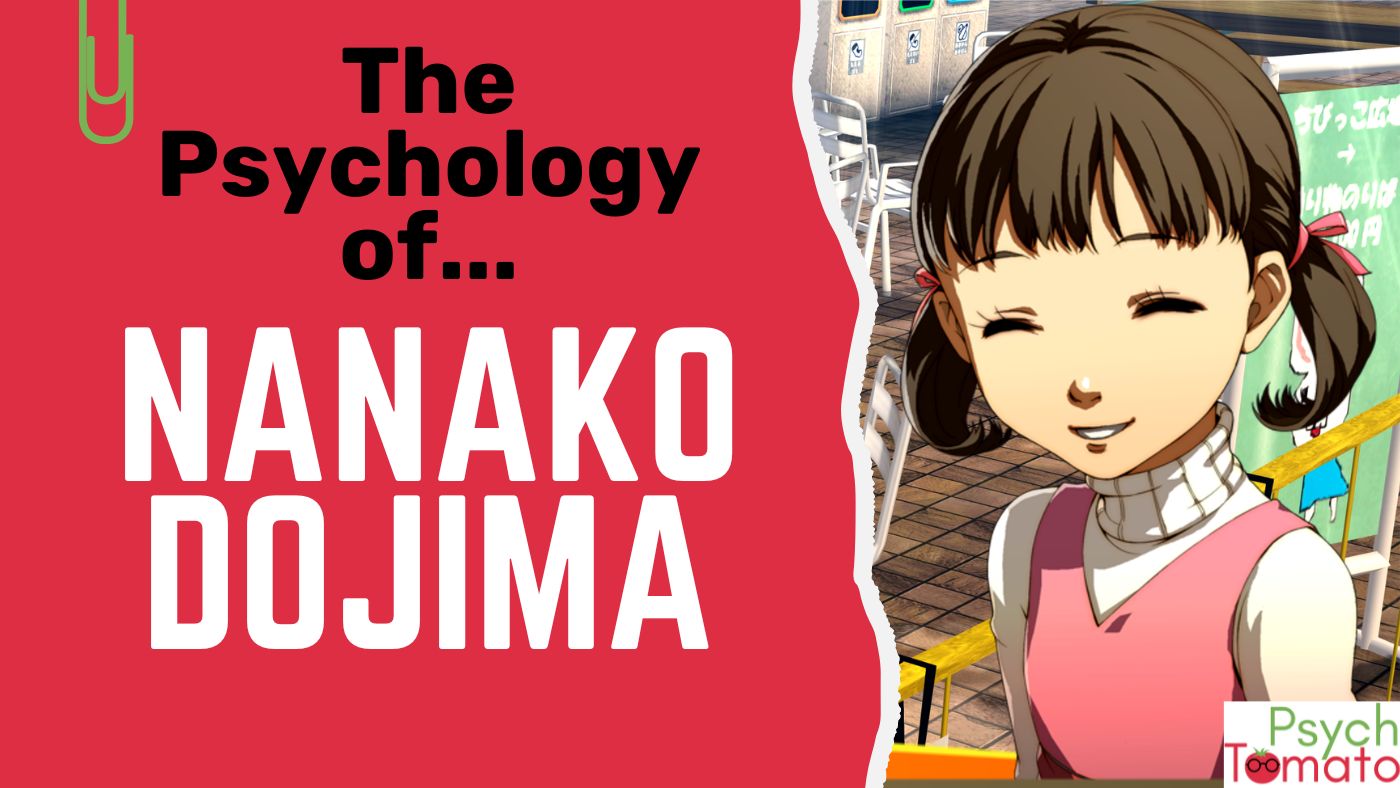
Nanako Dojima can cook dinner, do the laundry, spend long evenings by herself, and sing the Junes jingle with the commitment of a tiny regional advertising executive.
Persona 4 presents much of this as adorable, and some of it absolutely is. That said, some of it should make every adult in the room immediately sit up a little straighter…
Nanako is six-going-on-seven when we meet her. She has already lost her mother, and she lives with a father who loves her fiercely but is often absent in body and even more absent in conversation.
Nanako Dojima’s personality is commonly summarized with three easy words: sweet, innocent, and mature. All three of these are true, but none of them are necessarily sufficient.
She is also curious, observant, angry when she has every right to be, and far too practiced at making herself easy to leave alone.
Any honest Nanako Dojima character analysis has to hold two truths at once: her capability is genuine, and a child should never have needed quite so much of it.
That last part is where her story really begins.
At its heart, Nanako’s arc asks an uncomfortable question: when a child appears remarkably resilient, are we seeing strength, support, or a child who has learned how little she can ask from the room?
Before We Begin: A Quick Note
Fair warning: this article contains major spoilers for Persona 4 and Persona 4 Golden, including Nanako’s Social Link, her kidnapping, the Heaven dungeon, and the hospital sequence. If you haven’t yet played the game and want to experience those moments firsthand, consider this your warning!
Also, just to be clear, this is not a clinical analysis of Nanako, and we’re not trying to diagnose a fictional child.
Instead, we’re using her story to explore real psychological ideas about attachment, childhood grief, family communication, and resilience.
The distinction matters, especially in Nanako’s case. Persona 4 gives us scenes to interpret, not the developmental history, observation, consent, or assessment needed to make clinical claims.
Meet the Character: Nanako Dojima’s Personality at a Glance
Nanako Dojima is the young daughter of Detective Ryotaro Dojima and the protagonist’s cousin. She is six when the game begins and turns seven during its calendar year.
Her mother died in a hit-and-run when Nanako was younger. Since Dojima’s work frequently keeps him away from home, Nanako has become unusually capable for her age. She cooks, handles household chores, and spends many evenings watching television alone.
She also loves Junes with an enthusiasm that must surely have somebody in corporate marketing sleeping very well at night.
Psychologically, her defining characteristics are:
- Public face: Polite, cheerful, helpful, and remarkably self-sufficient
- Private conflict: Grief, loneliness, and the fear that absence means rejection
- Central psychological need: Reliable presence and honest reassurance
- Strengths: Empathy, curiosity, warmth, adaptability, and moral seriousness
- Habit: Making herself useful while asking for very little
- Risky adult misreading: Assuming that competence means she is fine
- Core tension: Her joy is genuine, but so is the pain underneath it
Now, note that Nanako is not simply a tiny adult wearing pigtails. She thinks concretely, asks blunt questions, delights in small rituals, and occasionally misunderstands the world in precisely the way a young child would.
That mixture of capability and childhood is what makes her feel real.
The Empty Living Room Is Its Own Kind of Dungeon
Most of Persona 4’s character conflicts eventually become surreal dungeons full of monsters, symbolism, and architecture in seriously urgent need of a safety inspection.
Yet Nanako’s begins in a living room.
The protagonist comes home, Dojima is working late, and Nanako is watching television, folding laundry, or waiting for somebody to talk to her.
Nothing dramatic needs to happen here… which is exactly why the pattern matters…
Dojima has understandable reasons for being away. After all, Inaba is dealing with a murder investigation, he is responsible for public safety, and his wife’s unresolved death still haunts him.
However, a reason can be perfectly understandable and still have consequences.
Children experience patterns, after all, not prosecutorial closing arguments.
From the perspective of attachment theory, children look to caregivers as sources of safety, comfort, and reliable availability. Mary Ainsworth’s foundational work helped describe the caregiver as a secure base from which a child can explore and a safe haven to return to when distressed.1
Now, that does not mean that we can assign Nanako an attachment style from just a handful of video game scenes. We can’t, and doing so would turn an interpretive lens into a diagnostic label with impressive speed and very little evidence.
What we can say, though, is that Nanako repeatedly asks an attachment-shaped question: When I need you, will you be there?
Our protagonist matters because he gives that question a dependable answer. He comes home, he listens, he goes to Junes with her, helps in the garden, cooks beside her, and stays for just one more conversation before bed.
He doesn’t erase her grief or replace her father. That would be a remarkably tall order… However, he does expand the number of places where Nanako can safely reach for connection.
“Are Bad People More Important Than Me?”
One of the sharpest moments in Nanako’s Social Link arrives when she tries to understand why Dojima is always at work. In that innocent yet also brutally direct way, she asks whether the “bad people” he chases are more important to him than she is.
It’s tempting to answer with adult logic, right? After all, Dojima is protecting Inaba! His job is important! Logically, we want to explain that his absence doesn’t mean that he loves her any less.
All of that is reasonable. Perfectly reasonable, even!
However, none of it gives Nanako her father back for the evening.
When the protagonist tells her that Dojima is protecting everyone, Nanako’s response cuts through the abstraction: “Does that mean everyone else is more important?”
It’s quite the gut punch, isn’t it? Nanako isn’t being selfish. She is just comparing the observable evidence.
Adults often treat love as an internal fact: “Of course I love you! You should know that!”
Children, quite reasonably, look for the receipts.
Do you come home? Do you listen? Did you attend the school meeting? When you promise “next time,” does that “next time” ever actually arrive?
The major tragedy at play in the Dojima household isn’t an absence of love. We, as the player, see and know that clearly. However, the tragedy is more specifically that love and availability have gradually drifted apart.
As we explore more deeply in our analysis of Ryotaro Dojima, his grief turns into casework. He keeps investigating, keeps moving, and keeps telling himself that duty to the dead justifies distance from the living.
It’s Nanako who is then left to experience the other side of that bargain.
What Does “Real Family” Mean?
Nanako’s Social Link repeatedly returns to the word “real.”
While watching a documentary about someone searching for his “real father,” she asks what the phrase means. Depending on the player’s answer, she decides that the protagonist is her “real” big brother because he loves her or because he is always there.
Then the thought turns… well… darker…
To Nanako, if presence is evidence of family, what then does Dojima’s absence mean? Could she somehow not be “real” to him?
That conclusion is seriously heartbreaking, but it follows a child’s logic with terrible efficiency.
Love may be invisible to adults. At six, evidence usually helps.
By the end of her Social Link, Nanako gives the protagonist a Family Picture and imagines taking a new one with him and Dojima. Family has expanded beyond biology without making biology irrelevant. The protagonist belongs because he has participated in the daily work of belonging.
When you think about it, the Justice Arcana is rather fitting here, eh?
Nanako is not asking for some kind of abstract definition of family. She is asking whether the care within one is being distributed fairly.
There is, however, an important complication worth addressing…
At the end of the Social Link, Nanako says that she and Dojima have both been lonely since her mother died and that she needs to work hard so her father will not feel lonely.
It’s a beautiful expression of empathy, sure, but it’s also a tremendous amount of responsibility for a child to carry.
Current guidance from the American Academy of Pediatrics notes that bereaved children may hide their own concerns or begin supporting a struggling surviving caregiver. Adults can then mistake that helpfulness for evidence that the child needs no help herself.2
A child can participate in family care, of course. However, they should not become the family’s emotional maintenance department.
Childhood Grief Is Not Smaller Grief
During her Social Link, Nanako asks what happens when people die. She wonders why her mother left her. She revisits memories of the family picking flowers together by the Samegawa River.
These aren’t random questions placed there to make the player cry (although, let’s be real, Persona 4 certainly knows what it’s doing in that department…)
These questions reflect the way a young child gradually builds an understanding of death.
Developmental research suggests that children begin conceptualizing death as a biological event around age five or six, while their understanding of ideas such as irreversibility, universality, and causality continues to develop.3
That makes Nanako’s questions especially believable. She is old enough to understand that her mother is gone, but still young enough to be constructing what “gone” actually means.
To that point, we should also correct a certain common oversimplification here: children do not all grieve one way, and adults do not all grieve another.
Nanako can talk about death, become absorbed in television, laugh with the protagonist, and get excited about Junes without any one of those reactions necessarily cancelling the others out.
Grief isn’t a permanent facial expression. Her joy can be genuine while her loss still remains unresolved.
That’s one of the biggest reasons why Dojima’s silence matters so very much. His reluctance to discuss Nanako’s mother may come from pain, guilt, or the belief that avoiding the subject protects his daughter. To Nanako, though, the missing photographs and missing conversation create an information vacuum.
As it happens, children are exceptionally talented at filling those vacuums.
Unfortunately, the explanation they invent is often crueler than the truth.
Nanako wonders whether her mother chose to leave, whether Dojima threw the photographs away, and whether he might eventually throw her away as well.
The healthier response is not a perfect speech that magically makes the grief disappear. Instead, it’s repeated, developmentally appropriate honesty and the willingness to let the question be asked again.
Why Is Nanako’s Dungeon Called Heaven?
Late in the story, Nanako is kidnapped and thrown into the TV World. The Investigation Team finds her inside a dungeon called Heaven, a beautiful and unsettling place shaped by images of her mother, loneliness, and the wish not to be left alone.
It would be wildly reckless to treat that symbolism as evidence that Nanako wants to die. The game never gives us enough basis for that conclusion.
Nanako has been told that her mother is in Heaven. So, when the TV World gives architectural form to her grief, Heaven is the only address she has been given for the person she misses.
The dungeon can more defensibly be read as a child’s longing for reunion, safety, and a place where the people she loves finally stop disappearing.
That’s a symbolic interpretation, mind you, not a clinical claim. The distinction is especially important here because grief-related questions or symbolic imagery are not, by themselves, a clinical assessment.
In real life, any child who says they want to die should be taken seriously and supported by a qualified adult or professional. Nanako, however, never gives us that statement, so the dungeon alone cannot carry that claim.
Heaven is so frightening not because it reveals a secret wish to die, but because it turns all of Nanako’s unanswered questions into a place that the player now has to walk through.
Resilience Is Not the Same as Being Fine
Nanako is truly and remarkably resilient.
She forms new relationships, continues to find pleasure in ordinary life, expresses affection, adapts to change, and eventually speaks more openly about what she needs.
But resilience is one of those words that becomes dangerous when we turn it into applause for enduring avoidable hardship.
Modern resilience research describes it as the capacity of a dynamic system to adapt successfully through processes that operate across the person, family, school, community, and other connected systems.4
In other words, resilience isn’t a magical substance stored somewhere behind Nanako’s smile. It grows through relationships and resources.
The protagonist’s most psychologically meaningful contributions are almost aggressively ordinary: shared meals, small outings, patient answers, predictable evenings, and attention that doesn’t need to be earned through a crisis.
None of these acts brings Nanako’s mother back, nor do they solve every problem in the Dojima household. However, they do make the household more livable.
That is what support often looks like before anyone turns it into an inspirational poster.
Now, this also means we should be careful about praising Nanako for being “mature for her age.” Her competence is real and genuinely impressive. However, competence does not prove that the burden was appropriate.
A smile is not medical clearance.
Nanako does not become resilient because she needs nobody. She becomes more able to adapt when she no longer has to face everything alone.
Nanako Is More Than Innocence in Pigtails
Nanako’s kidnapping and hospitalization provide Persona 4 with one of its most powerful emotional turns. Her apparent death pushes the Investigation Team toward a terrible decision: whether or not to throw Namatame into the TV World and call revenge justice.
That sequence works because the player cares about her. (I’ll freely admit that I even had to just walk away from the game for a little bit to process the gut-punch of that part of the story.)
However, it also risks reducing Nanako to, basically, an emotional detonator whose suffering exists to force everybody else’s character development.
Fortunately, her Social Link gives her more interior life than that.
Nanako is not endlessly passive or angelically agreeable. There are plenty of scenes that prove as much! She gets angry when Dojima dismisses her school form, she runs away, and she questions whether he loves her. She asks about death, crime, blood, and family with the unnerving directness of a child who has noticed that the adults are avoiding something.
Nanako isn’t important merely because she is innocent enough to inspire everyone else. She is important because she is a person whose needs remain real even when the adults have excellent reasons for being so busy.
The hospital scene tests the Investigation Team’s morality. The rest of Nanako’s story, however, tests their willingness to show up before catastrophe makes showing up unavoidable.
Beyond Inaba: When “Mature for Her Age” Is a Warning
Nanako’s circumstances are unusually dramatic, but the underlying pattern is far from it.
Children often adapt to the emotional weather of a household long before they actually have the language to describe it. Some become louder. Some become angrier. Others become exceptionally helpful, quiet, and easy to manage.
The quiet version is easier for adults to reward. That said, it’s not automatically healthier.
Nanako’s story leaves us with several useful questions:
- Is this child coping, or have they learned that their needs disrupt the room?
- Does “mature” mean “well-supported”, or does it merely mean “convenient”?
- When a child repeats a painful question, do the adults answer it or hastily change the subject?
- Is love being communicated in a form that the child can actually experience?
- Who is supporting the grieving caregiver so the child doesn’t have to do it?
Persona 4 explores grief at several stages of life. In the Death Arcana Social Link, Hisano Kuroda’s story looks backward across a long marriage, while Nanako is still trying to build the basic concepts with which loss can be understood.
The ages are different, but the need to speak the loss aloud isn’t.
Tomato Takeaway
Nanako Dojima’s personality is most certainly not defined by grief. We quickly learn that she’s warm, curious, observant, funny, morally serious, and devastatingly good at making do.
Her resilience is real, but it’s not proof that being left alone was harmless. Nor, for that matter, does it mean that her smile somehow cancels her loneliness.
Nanako begins the story trying to understand why people leave. Through honest conversation, ordinary routines, and relationships that become reliable, she gradually learns something more useful: family is not only the people connected to you by blood but the people who keep showing up.
A loving family isn’t one where nobody ever feels lonely; it’s one where loneliness doesn’t have to hide to keep the peace.
But, as we wrap up, now it’s your turn to join the conversation!
Which Nanako scene hit you the hardest? Did her Social Link change the way you understood her relationship with Dojima?
Share your thoughts in the comments below! I’d love to hear how Nanako’s story resonated with you!
Sources and Further Reading
- Ainsworth, M.D.S., Blehar, M.C., Waters, E., & Wall, S. (1979). Patterns of Attachment: A Psychological Study of the Strange Situation (1st ed.). Psychology Press. https://doi.org/10.4324/9781315802428 ↩︎
- Schonfeld, D. J., Demaria, T., Nasir, A., Kumar, S., Committee on Psychosocial Aspects of Child and Family Health, & Council on Children and Disasters. (2024). Supporting the grieving child and family: Clinical report. Pediatrics, 154(1), e2024067212. https://doi.org/10.1542/peds.2024-067212 ↩︎
- Slaughter, V. (2005). Young children’s understanding of death. Australian Psychologist, 40(3), 179–186. https://doi.org/10.1080/00050060500243426 ↩︎
- Masten, A. S., Lucke, C. M., Nelson, K. M., & Stallworthy, I. C. (2021). Resilience in development and psychopathology: Multisystem perspectives. Annual Review of Clinical Psychology, 17, 521–549. https://doi.org/10.1146/annurev-clinpsy-081219-120307 ↩︎

Fueled by coffee and curiosity, Jeffrey is a veteran blogger with an MBA and a lifelong passion for psychology. Currently finishing an MS in Industrial-Organizational Psychology (and eyeing that PhD), he’s on a mission to make science-backed psychology fun, clear, and accessible for everyone. When he’s not busting myths or brewing up new articles, you’ll probably find him at the D&D table or hunting for his next great cup of coffee.