
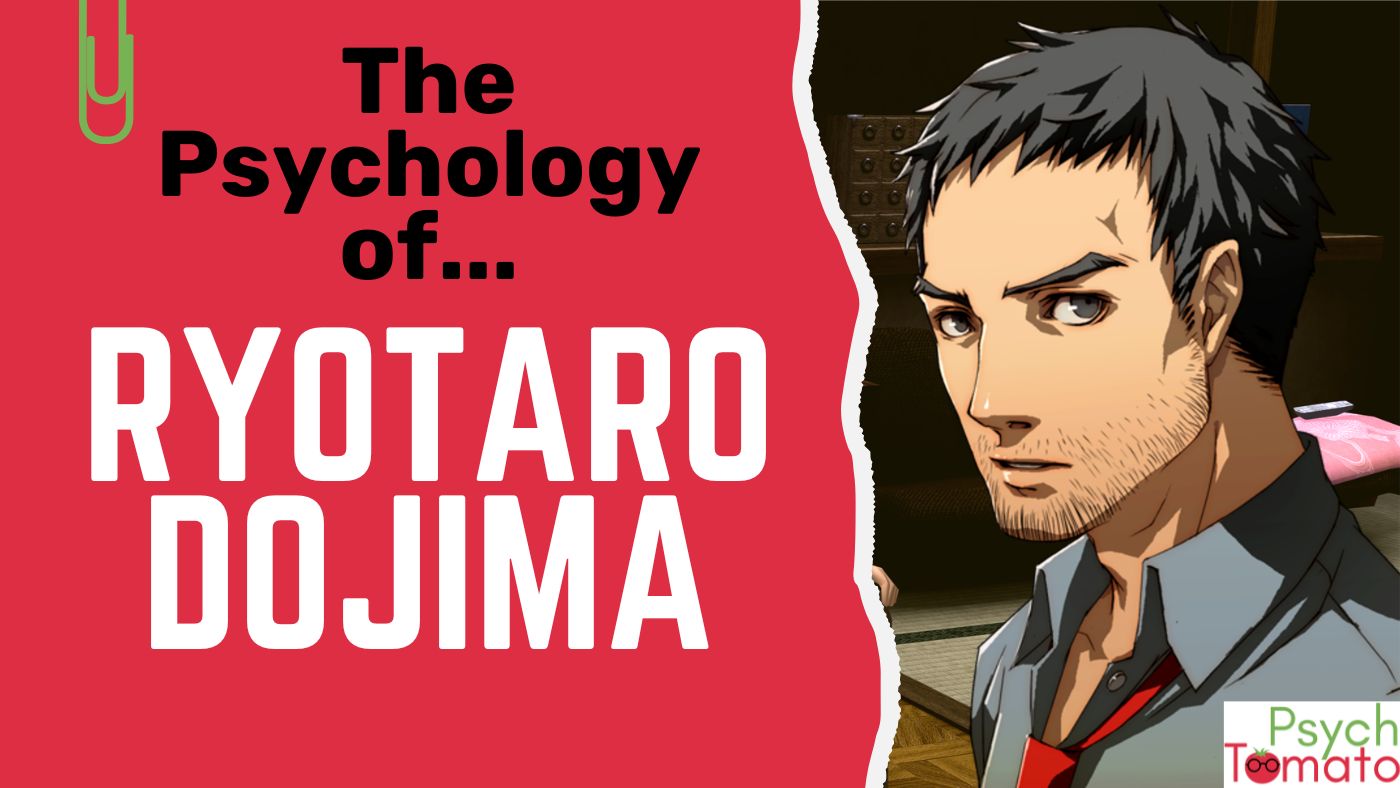
Detective Ryotaro Dojima can question a suspect, read a crime scene, and stare down a teenager who has clearly been doing something peculiar in the Junes electronics department.
Ask him to explain grief to his daughter, though, and the detective suddenly misplaces the manual.
That contradiction lies at the heart of Dojima’s character in Persona 4. He is a decent man, a devoted police officer, and a father who unquestionably loves his daughter. However, he is also emotionally unavailable, chronically absent, and so consumed by the unsolved death of his wife that Nanako is left growing up beside a case file.
Dojima’s problem isn’t a lack of love. It is the distance between love as an internal feeling and love as something another person can actually experience.
And children, inconveniently, cannot read minds…
Before We Begin: A Quick Note
Fair warning: this article contains major spoilers for Persona 4 and Persona 4 Golden, including Dojima’s Social Link and events surrounding Nanako’s kidnapping.
It is also an interpretation, not a diagnosis. Psychological theories can help us understand fictional characters, but Dojima is made of dialogue, pixels, and a heroic tolerance for instant coffee. He is not a clinical patient.
Meet the Character: Ryotaro Dojima’s Personality at a Glance
Ryotaro Dojima is Nanako’s father, Yu Narukami’s uncle and guardian, and a detective with the Inaba Police Department.
At first glance, he is the familiar gruff-but-dependable authority figure type of character. He works long hours, keeps his feelings close to the chest, and shows affection through protection rather than conversation. He is suspicious of Yu’s increasingly strange behavior, but his suspicion comes from genuine concern.
Beneath that exterior, however, Dojima is carrying several unresolved conflicts:
- His public identity: A capable detective responsible for protecting Inaba.
- His private wound: The hit-and-run death of his wife, Chisato.
- His central fear: Loving another family and losing it again.
- His default defense: Turning pain into work.
- His greatest strength: A real capacity for loyalty, responsibility, and change.
- His greatest blind spot: Believing that good intentions will eventually explain years of absence.
- His core psychological need: To become a father who is present, not merely protective.
Dojima isn’t torn between loving his family and not loving them. He is torn between being emotionally present with that family and retreating into a role where every problem appears to be actually solvable.
A Detective Who Cannot Close the Case
Well before our arrival in Inaba, Dojima’s wife Chisato was killed by a hit-and-run driver while on her way to collect Nanako from nursery school. There were no useful witnesses, the driver was never identified, and Nanako was left waiting for a mother who would never arrive.
The loss strikes three major parts of Dojima’s identity all at once.
As a husband, he couldn’t save Chisato.
As a father, he couldn’t protect Nanako from losing her mother.
As a detective, he couldn’t catch the person responsible.
While all three of those are seriously heavy blows, that last failure matters enormously. After all, Dojima works in a profession that’s built around evidence, suspects, and conclusions. A crime is supposed to move from confusion toward an answer.
Yet, in the darkest moment of his life, grief offers him none of those courtesies.
The cold case therefore gives his pain a direction. There is someone to find, evidence to reexamine, and a theoretically reachable moment when justice might be done. Grief is an open question. Dojima makes his living arresting answers.
Now, note that wanting to solve Chisato’s case isn’t inherently unhealthy. A woman was killed, and the person responsible escaped. Justice matters. Of course, it’s even more personal considering that the victim was his wife!
But an action can be both meaningful and avoidant. Dojima can pursue the case because he is a detective while also using that pursuit to avoid being a grieving husband and frightened father.
To borrow from a mentor of mine, “two things can be true before breakfast.” Psychology becomes considerably more useful once we get comfortable with that.
When Grief Puts On a Work Uniform
It would be all too easy to flatten Dojima’s story into a familiar lesson: emotionally reserved man suppresses his feelings, therefore emotionally reserved man is unhealthy.
But, if the Persona games teach us anything, it’s that such a reading is much too tidy.
Research on bereavement gives us good reason not to treat every quiet mourner as a malfunctioning one. Psychologist George Bonanno has argued that people follow several different trajectories after loss and that relatively stable functioning can represent genuine resilience rather than denial or pathology.1
Dojima does not need to cry more loudly to prove that he loved Chisato. There is no compulsory performance of grief, and visible distress is not some kind of authenticity meter.
The Dual Process Model of bereavement offers a more useful lens. It describes coping as movement between confronting the loss and attending to the practical demands of continuing life. People may need both engagement and respite rather than uninterrupted immersion in grief.2
Work can be part of that continuing life. Routine, responsibility, and helping other people may all provide an important sense of structure after a loss.
The problem, though, is rigidity.
Dojima doesn’t simply return to work. He instead builds his life around the unresolved case, brings it home, sacrifices family promises to it, and tells himself that Nanako will understand someday. The investigation becomes both an altar to Chisato and a bunker from everyone who remains.
His badge isn’t the villain here. More specifically, it’s serving as his camouflage.
Silence Is Still Communication
One of the most revealing moments in Dojima’s Social Link occurs when a television report describes another fatal traffic accident. Dojima immediately tells Nanako to turn it off and leaves the room.
Nanako then explains that her mother died in an accident… and that her father refuses to talk about it…
From Dojima’s perspective, silence may feel protective. If he doesn’t discuss Chisato, perhaps he can avoid upsetting Nanako, exposing his own pain, or confronting the humiliation of being a detective who could not solve his own wife’s death.
Unfortunately, hiding an emotion does not dispose of it. It merely changes who has to guess what is happening.
In one controlled study, participants instructed to conceal their emotional expressions showed fewer outward signs of emotion but greater activation in parts of the body’s stress response.3 Another pair of experiments found that expressive suppression could disrupt communication and reduce rapport during conversations.4
Now, note that those studies had important limits: the first involved 180 women watching films, while the latter involved previously unacquainted pairs of women discussing upsetting subjects. Neither proves that a fictional Japanese detective will damage his family by keeping a straight face.
A laboratory is not Inaba.
What the studies do illustrate, though, is a smaller and much more defensible point: making an emotion less visible does not necessarily make the internal or interpersonal consequences disappear.
This becomes especially important with children, by the way.
A current American Academy of Pediatrics clinical report notes that grieving children may hide their questions because they don’t want to burden distressed adults. Avoiding the subject can also leave children to misinterpret why adults won’t discuss what happened. The report recommends honest, developmentally appropriate communication rather than assuming silence is reassuring.5
Dojima thinks he is containing the pain and protecting his daughter. The cruel tragedy, though, is that Nanako experiences a father who leaves whenever the subject approaches.
Silence is still communication. It’s simply communication without the courtesy of clarity.
“Are Bad People More Important Than Me?”
In Nanako’s side of the story, Dojima’s absence becomes a question she is too young to answer accurately: Are bad people more important to Dad than I am?
It is a devastating question precisely because the answer is obviously a resounding “no.” However, from Nanako’s perspective, Dojima’s behavior keeps making it look like yes.
During the family’s parent-teacher interview dispute, Nanako wants him to complete a scheduling form and attend. Dojima responds as though this is one more obligation competing with police work. To him, the conflict concerns time. To Nanako, it concerns rank.
Where does she sit on her father’s list?
This is where attachment theory becomes so relevant. Children don’t experience caregiver love as an abstract principle. They learn about availability through repeated interactions: whether a caregiver notices, responds, returns, and can be relied upon when comfort is needed.
Now, that doesn’t mean that every missed dinner constitutes emotional abandonment. Detectives don’t schedule crime, single parents cannot somehow summon unlimited childcare, and some families work punishing hours because rent remains ever-so-stubbornly unimpressed by good intentions.
But Persona 4 shows more than an unavoidable scheduling problem. Dojima gives discretionary time to Chisato’s cold case, works on it at home, breaks promises, and repeatedly borrows understanding from a future version of Nanako.
“She will understand someday,” he reasons.
And perhaps she just might… But that doesn’t change the fact that he is effectively spending her childhood on credit.
Providing for a child is love. Protecting a child is love. Showing up is also love. The problem here isn’t that the first two are fraudulent; it is that children generally need more than one dialect.
When the Interrogation Room Comes Home
Dojima’s professional instincts aren’t entirely wrong about our character, Yu.
Think about it!
His nephew is disappearing after school, behaving evasively, frequenting the electronics department at Junes, and somehow orbiting every major development in an active murder investigation. Dojima may very well be the only adult in Inaba to notice that our protagonist is behaving like the protagonist of a video game! (How’s that for “meta”, eh?)
But, jokes aside, his concern is perfectly reasonable. After all, Yu is a teenager who seems totally intent on involving himself in something extraordinarily dangerous… for some reason…
The problem is that Dojima knows how to interrogate FAR BETTER than he knows how to invite honesty.
As such, he probes, pressures, and falls back on authority. When he discovers a threatening letter addressed to Yu, he brings him to the police station for questioning. In doing so, he leaves Nanako at home without fully understanding the danger actually surrounding the family.
Now, Namatame’s decision to kidnap Nanako belongs to Namatame. Dojima is not responsible for another man’s crime.
That said, though, the sequence nevertheless reveals what happens when Dojima’s “detective” role swallows his “father” role. He becomes so focused on extracting answers from Yu that he fails to ask which member of the household currently needs protection most urgently.
Authority can produce compliance, but it can’t manufacture trust.
Dojima wants Yu to tell him the truth, but he has built a household in which difficult truths are quickly greeted with suspicion, withdrawal, or a change of subject. The interrogation room has followed him home.
Crisis Makes His Love Visible
Once Nanako is kidnapped, any and all ambiguity about Dojima’s love disappears.
He pursues Namatame’s truck, crashes during the chase, and tries to continue despite his injuries. From his hospital bed, he entrusts Nanako’s rescue to Yu and the Investigation Team because he physically cannot reach her himself.
Later, as Nanako’s condition worsens, Dojima’s professional composure collapses entirely.
No plausible reading of these scenes suggests that he is indifferent. He loves Nanako fiercely, and he would clearly risk his life for her without even a moment’s hesitation.
That’s also what makes his earlier absence so painful.
Crisis allows Dojima to express love in the language he understands best: pursuit, danger, sacrifice, protection. The required action is immediate and unmistakable.
Ordinary parenting is less cinematic, though. It asks for bedtime stories, school forms, awkward conversations, and being mentally present after an exhausting shift. There’s no suspect to chase down and no flashing red light to confirm that the moment matters.
Dojima is prepared to die for Nanako, of that we can be sure. What his character arc asks, though, is whether he can also learn to come home for her.
The “dramatic sacrifice” aspect of that love is real, but so is the neglected Tuesday evening.
Repair Requires More Than a Confession
As we spend more time bonding with him, Dojima’s Social Link eventually forces him to admit something harsher than simple overwork.
Nanako increasingly resembles Chisato. Being with his daughter therefore reminds him of both the woman he lost and the possibility of losing another family member. At his worst, part of him even associates Chisato’s death with the fact that she was travelling to collect Nanako.
Dojima obviously knows that Nanako isn’t responsible. Still, the association helps explain why closeness became so frightening.
By pursuing the driver, he can remain connected to Chisato without risking the vulnerability of fully reconnecting with his daughter. Revenge (or justice, depending on the moment) becomes an excuse to keep moving.
This realization is the hinge of his story.
Dojima doesn’t ultimately abandon the investigation. Instead, he changes his relationship with it. He can continue looking for the driver because doing so is part of his work and his values, not because the case gives him permission to disappear from his family.
The behavior may look similar from the outside looking in, but notice how its psychological function has changed.
More importantly, repair begins to appear in ordinary actions.
He starts to talk about Chisato, acknowledges Nanako’s loneliness, and makes deliberate time for his family. He even gives Yu a coffee mug matching the ones that he and Nanako use, quietly transforming a temporary houseguest into a full-fledged member of the household.
It is not a grand object, but that’s why it works.
A mug belongs to the daily rituals of family life: morning coffee, familiar cupboards, and the assumption that you will still be there tomorrow. Dojima’s repair isn’t complete because he delivers one cathartic speech. It becomes credible because he starts behaving differently afterward.
Realistically, Nanako forgives with the generous speed of a warm-hearted video game. Actual children, however, are not obligated to make an adult’s redemption narratively efficient.
But the principle here still holds: repair requires changed behavior, not just remorse.
Does Grief Excuse Dojima?
No.
It explains him, sure, but that’s not the same thing.
Dojima has perfectly understandable reasons for withdrawing as he has, but a good reason can still produce a bad pattern. Nanako is frequently left alone. Her questions about her mother go unanswered. Promises are broken, and her competence is mistaken for proof that she requires less care.
His suffering does not erase those consequences.
At the same time, accountability does not require turning him into a villain. Dojima is capable of recognizing harm, tolerating the shame of that recognition, and changing course. That capacity absolutely matters!
Context without accountability becomes indulgence. On the other hand, accountability without context becomes contempt. Dojima deserves neither.
He’s a grieving man who hurts his daughter while trying to protect her and who eventually becomes brave enough to notice the difference.
Dojima and Adachi: Duty Is Not the Difference
Dojima’s relationship with Tohru Adachi offers one of the game’s most revealing adult contrasts.
Both men work in the same police department, both are isolated, and both have lives that entirely failed to become what they expected.
That said, though, they do not inhabit the same moral universe.
When Dojima is hurt, he withdraws into work. When Adachi feels cheated by life, he converts disappointment into entitlement and contempt. Dojima can neglect relationships, but he still recognizes that other people place legitimate demands upon him. Adachi experiences those demands as an insult.
Most importantly, Dojima can be corrected.
He can listen, feel remorse without turning that remorse into self-pity, and accept that love obligates him to change. His sense of duty may become armor, but it never completely destroys his capacity for connection.
The difference between the two detectives isn’t that one bears responsibility while the other avoids it. We clearly see how both men resent burdens at various points.
The key difference between them is what they do when reality refuses to flatter them.
Dojima eventually returns to building his relationships, while Adachi instead retreats further into contempt.
Beyond Inaba: Providing, Presence, and the Parents Who Are Tired
Dojima’s story isn’t a sermon against working parents and shouldn’t be treated as such.
Some caregivers miss dinners because they are doing whatever it takes to keep the lights on. Some are managing unpredictable shifts, illness, poverty, inadequate childcare, or several crises at once. “Be more present” is rather cheap advice when it arrives without time, money, or practical support attached.
The useful distinction here is not between parents who work and parents who do not. Getting more specific, it’s between unavoidable absence and emotional disappearance.
Presence can be modest:
- Giving a child an honest, age-appropriate explanation rather than leaving them to invent one.
- Creating small rituals that remain dependable even when life gets chaotic.
- Acknowledging a broken promise instead of demanding automatic understanding.
- Making affection observable through attention and follow-through.
- Seeking adult support so a child doesn’t become the household’s grief counselor.
Now, none of these requires perfect parenting. Perfect parenting, much like a perfectly solved case in Inaba, is mostly a fictional device.
What they do require is repair, predictability, and the willingness to let another person’s experience complicate our good intentions.
Persona 4 explores grief again through characters such as Hisano Kuroda (the Death Arcana), whose widowhood takes a very different shape. Together, these stories resist the idea that bereavement wears one costume or follows one respectable timetable.
Tomato Takeaway
By the end of the game, Ryotaro Dojima doesn’t become a better father by choosing Nanako instead of his badge. Instead, he starts refusing to use that badge as a place to hide from her.
He can still continue investigating Chisato’s death. He can remain a detective, protect Inaba, and answer the phone when duty calls. What changes is that the case no longer gets to make every decision for his family.
His love for Nanako was certainly always real, but his growth lies in making that love visible before another emergency drags it into the open.
That may be the most adult lesson in Dojima’s story: intentions happen inside us, but relationships happen between us. Love can be sincere and still fail to arrive. Repair begins when that love finally comes through the door.
But now it’s your turn to join the conversation!
Have you ever tried to stay strong for someone else, only to realize that opening up was what really brought you closer?
Share your thoughts in the comments. I’d love to hear how Dojima’s story resonates with your own!
Sources and Further Reading
- Bonanno, G. A. (2004). Loss, trauma, and human resilience: Have we underestimated the human capacity to thrive after extremely aversive events? American Psychologist, 59(1), 20–28. https://doi.org/10.1037/0003-066X.59.1.20 ↩︎
- Stroebe, M., & Schut, H. (1999). The dual process model of coping with bereavement: Rationale and description. Death Studies, 23(3), 197–224. https://doi.org/10.1080/074811899201046 ↩︎
- Gross, J. J., & Levenson, R. W. (1997). Hiding feelings: The acute effects of inhibiting negative and positive emotion. Journal of Abnormal Psychology, 106(1), 95–103. https://doi.org/10.1037/0021-843X.106.1.95 ↩︎
- Butler, E. A., Egloff, B., Wilhelm, F. H., Smith, N. C., Erickson, E. A., & Gross, J. J. (2003). The social consequences of expressive suppression. Emotion, 3(1), 48–67. https://doi.org/10.1037/1528-3542.3.1.48 ↩︎
- Schonfeld, D. J., Demaria, T., Nasir, A., Kumar, S., Committee on Psychosocial Aspects of Child and Family Health, & Council on Children and Disasters. (2024). Supporting the grieving child and family: Clinical report. Pediatrics, 154(1), e2024067212. https://doi.org/10.1542/peds.2024-067212 ↩︎

Fueled by coffee and curiosity, Jeffrey is a veteran blogger with an MBA and a lifelong passion for psychology. Currently finishing an MS in Industrial-Organizational Psychology (and eyeing that PhD), he’s on a mission to make science-backed psychology fun, clear, and accessible for everyone. When he’s not busting myths or brewing up new articles, you’ll probably find him at the D&D table or hunting for his next great cup of coffee.