
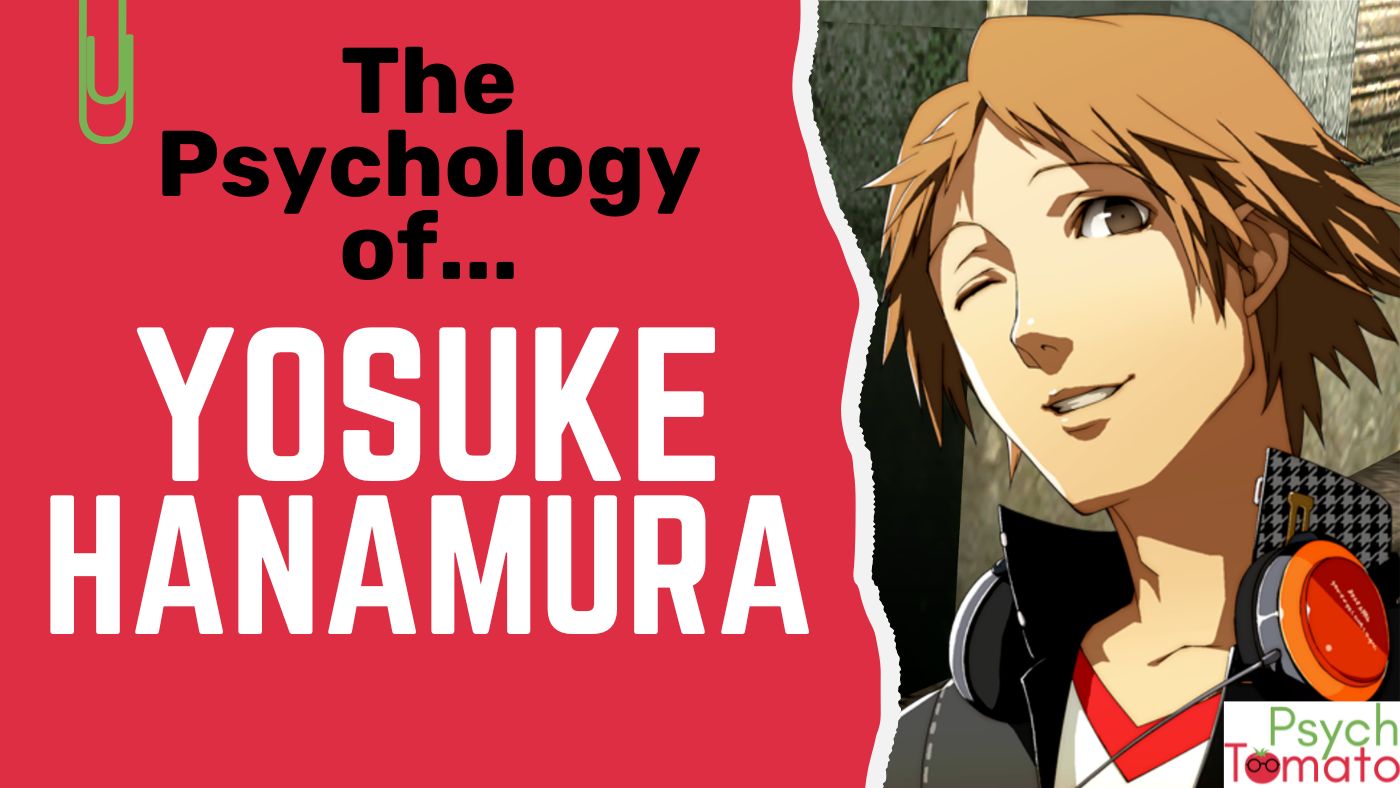
Yosuke Hanamura keeps getting spam messages. Sure, he could change his address, but someone from his old life might eventually contact him. Calling those people to announce a change feels risky: what if they find him annoying? So he keeps the address and waits.
For a character who makes so much noise, it’s a remarkably quiet way of showing loneliness.
Yosuke’s jokes and enthusiasm make him easy to recognize as the Investigation Team’s outgoing friend. However, as we get to know him better, his Social Link reveals how uncertain he can feel about what friendship actually means for him. He wants company, but he also wants evidence that he matters.
The psychology of Yosuke Hanamura centers on a question many people find uncomfortable: how do you feel secure in a friendship when you keep comparing yourself with the person beside you? His grief for Saki, attraction to adventure, and envy of the protagonist all make that question unusually personal.
Before We Begin: A Quick Note
This article contains spoilers for Persona 4 and Persona 4 Golden. If you haven’t played the game and want to experience Yosuke’s growth firsthand, consider this your warning.
Also, a reminder: this isn’t a clinical diagnosis of a fictional character. Instead, we’re using Yosuke’s story as a way to explore some real psychological concepts. Think of it as looking at the science of the mind through the lens of pop culture, where psychology meets Persona.
Meet Yosuke Hanamura: The Manager’s Son
Yosuke moves from the city to Inaba, where his father manages the local Junes store. Like clockwork, that family connection constantly follows him into conversations he did not start. Early in his Social Link, he overhears some women discussing the store and the shopping district’s decline. He explains that people recognize him everywhere and that he has to watch how he behaves.
He’s arrived with a reputation supplied by his father’s employer. Whatever he thinks about the local businesses (many of which are struggling to compete with Junes), being the manager’s son makes him an accessible target for resentment.
His complaints about the countryside also complicate the picture. Moving away from the energy of the city to this sleepy countryside, he later admits that he initially felt above the place. Feeling out of place, disconnected, and stuck in a role he never asked for, he wants people to welcome him while struggling to appreciate the town they call home.
Psychologists Roy Baumeister and Mark Leary’s influential review describes belonging as a motivation to form and maintain lasting, positive relationships.1 Their account emphasizes both recurring contact and an enduring sense that people care about one another. Just like progressing the Social Links in the Persona games, familiarity alone doesn’t provide everything that such a bond offers.
That distinction helps us understand Yosuke. Being recognized around Inaba tells him little about whether people would actually choose his company. Even his former contacts leave him uncertain, and he eventually questions whether he can really call them friends.
Our protagonist gives Yosuke opportunities for something more reciprocal. They spend time together, talk, and become involved in a shared undertaking. Yosuke finally has somebody who he can call his partner.
Unfortunately, however, he also starts wondering whether his partner is the impressive one…
Ouch…
The Shadow and the Wish to Be a Hero
Yosuke’s Shadow Self accuses him of presenting himself as carefree because he fears being alone. It then attacks his explanation for entering the TV world: he wanted excitement, a chance to escape boredom, and perhaps an opportunity to become a hero. Saki’s death, the Shadow claims, merely provided the excuse.
And… yeah… This is a seriously brutal accusation to hear while grieving someone…
After the battle, Yosuke admits that shame made him deny feelings he recognized. Accepting his Shadow brings forth Jiraiya, but it also establishes the emotional work that Yosuke’s Social Link continues as we spend more time with him throughout the game.
It’s well worth noticing that Yosuke’s story isn’t as linear or cut-and-dried as it might initially seem. He has to acknowledge mixed motives. He can truly care about Saki while still finding the investigation exciting. Genuinely wanting to help others can absolutely coexist with wanting to become someone that people admire.
The Shadow naturally presents the most contemptuous account of those desires. However, we don’t have to adopt its claim that excitement was Yosuke’s only reason for caring. As we continue his Social Link, his later conversations give us a much fuller picture.
What makes the scene uncomfortable is how much Yosuke hopes the investigation will change his place in the world. In a town where he feels hopelessly stuck, suddenly there’s something extraordinary that he can do. The danger arrives with the promise that his life might finally feel important…
Saki and the Grief He Cannot Investigate Away
Saki Konishi had helped Yosuke feel welcome in Inaba. Her sudden death leaves him grieving a relationship that he was still trying to understand.
Inside the TV world, he hears a voice identified as hers expressing irritation with him and saying she was pleasant because he was the manager’s son. He also encounters the pressure surrounding her work at Junes and its effect on her family’s business.
These scenes confront him with parts of her life that he hadn’t understood. His crush didn’t mean they experienced their relationship in the same way, and her death removes the possibility of asking her about it.
Later, coworkers bring up Saki’s reported dislike of him while arguing with him. Yosuke defends her work and character. He’s already heard that she disliked him; what hurts is that she is gone and he’s still there.
His grief becomes especially clear when he produces a photo-booth sticker they took together after he arrived. Saki had encouraged him to see himself as separate from his parents. Even with his uncertainty about what she meant, those words had still helped him feel more welcome.
He cries because he wanted more time to talk with her and to get to know her better. He also admits that the case gave him somewhere to direct his attention so he could avoid her absence and his dissatisfaction with himself.
This all even further develops his earlier Shadow confrontation. He can now describe the loss that the excitement helped him avoid.
The scene allows Saki’s importance to remain complicated. Yosuke doesn’t need proof that she returned his feelings before her death can hurt. It was her kindness that mattered to him, and there were still things he didn’t know about her.
Our protagonist stays with Yosuke. That patience matters a great deal here, much as it does in Hisano Kuroda’s (the Death Arcana) Social Link. The immediate possibility is having company while facing something painful. Solving the case will not and cannot supply the conversations Yosuke wishes he could still have.
Why Yosuke Envies His Closest Friend
By the final part of his Social Link, Yosuke admits that he has been jealous of the protagonist. He expected another city boy to feel as bored and displaced as he did. Instead, though, his friend became a leader and gathered people around him. Yosuke admires him and feels proud of him, while also wanting his acknowledgment.
Friendship has given Yosuke someone important to him. However, comparison makes that same person a constant reminder of what he feels he lacks.
Abraham Tesser and colleagues’ self-evaluation maintenance framework2 offers a useful way to think about this. It proposes that someone close to us can become a particularly uncomfortable comparison when they outperform us in an area important to how we see ourselves. Their success in a less personally important area may instead give us something to feel proud of.
The researchers examined these ideas in three small experiments with female college students, using performance feedback involving friends and strangers. Their results offered partial support, with some predictions unsupported. Keep in mind, though, that the framework gives us an interpretive lens, rather than a universal rule about friendship.
For Yosuke, the sensitive issue is becoming significant. Our protagonist seems to achieve the recognition that Yosuke wanted, in the very town where he felt totally unable to find it.
That helps explain why reassurance through proximity has limits. Calling someone your partner doesn’t automatically stop you from ranking yourself beneath them. You can enjoy the friendship and still find yourself keeping a private scoreboard.
Yosuke eventually makes that comparison discussable. He admits the jealousy and says he wants them to stand as equals. Then, because this is Yosuke we’re talking about here, the conversation becomes a request to punch him.
The resulting brawl is the game’s dramatic expression of their reconciliation. The game itself even questions whether hitting him will make them “equal.” It gives us absolutely no reason to treat fighting as a useful way to resolve real friendships.
The more useful development is already underway well before the first punch, as Yosuke tells his friend something that threatens the image he would prefer to present. He lets the protagonist respond to the person experiencing envy, instead of expecting him to somehow resolve a comparison he’s never heard about.
When the Joke Makes Someone Else an Outsider
Understanding Yosuke’s wish for acceptance makes some of his behavior toward Kanji particularly… uncomfortable…
During the camping trip, Yosuke questions whether he and the protagonist will be safe sharing a tent with Kanji. When Kanji protests, Yosuke treats that reaction as further cause for suspicion. He pushes Kanji to prove that he can be comfortable around girls.
The exchange draws on a homophobic assumption that possible attraction to men makes Kanji a danger to them. It puts him in the position of having to defend himself to people who are supposed to be his friends.
For someone whose own acceptance has felt uncertain, Yosuke is remarkably willing to make Kanji’s experience of being judged worse.
Yosuke’s warmth and loyalty remain a big part of his character, but so does this behavior. The intimacy he develops with the protagonist doesn’t automatically demonstrate that he has learned to handle everybody else’s vulnerability with care.
That leaves his growth uneven. He becomes more willing to admit his own insecurity, while still giving us reasons to question how he responds to insecurity in others.
Finding Meaning in the Town He Dismissed
One of Yosuke’s gentlest moments happens on the hill overlooking Inaba. He remembers how much he disliked the town at first, but then recognizes that it now contains his family and friends. He explains that he thought being “special” would give his life meaning. Having a Persona once seemed to offer exactly that.
His understanding has changed, though. He can now imagine mattering to someone through the life and relationships he already has, without needing extraordinary abilities.
There’s a nice practical detail at the end of the scene as he and our protagonist look for their friends’ homes. The town becomes a place populated by people they know. Yosuke still has that same landscape in front of him, but now what he can see within it has changed.
This gives his story an alternative to chasing importance through the next emergency. There are ordinary relationships available to participate in, even on a day when nobody needs rescuing.
Beyond Inaba: Friendship Without Keeping Score
Leaving Inaba and returning to real life, the good news is that you don’t need to awaken a Persona to recognize the awkward discomfort of admiring a friend while still quietly comparing yourself with them. Perhaps they seem more confident, receive more recognition, or find their place in a group more easily. Being pleased for them and disappointed in yourself can easily happen in the same afternoon!
A useful question to consider is what their success has come to mean about you. There’s a pretty big difference between wanting to develop a skill and deciding that someone else’s strength makes your contribution irrelevant. Naming that difference can help you work out whether you want to learn something, ask for an opportunity, or reconsider the ranking you’ve brought into the friendship.
Of course, it may also help to notice what already makes the relationship valuable. The person who checks in, remembers the difficult anniversary, or turns up when plans just seem to totally fall apart contributes something that a strict comparison of achievements can miss. Friendship contains plenty of work that never earns a victory screen.
If you choose to discuss insecurity, you can describe your experience without making the other person responsible for continually disproving it.
Admitting that you’ve been comparing yourself with someone gives them information and opens the door for them to possibly help you develop those aspects that you admire about them. On the other hand, asking them to become less successful so you can feel secure puts a totally different demand on the relationship.
I think it’s worth pointing out that Yosuke also invites us to pay closer attention to our humor. When somebody objects to a joke, that response is worth hearing. Acknowledging what you said, apologizing, and changing how you treat them offers way more than explaining how insecure you felt when you said it.
Tomato Takeaway
Yosuke wants to belong, but he also wants belonging to prove that he is special. As we deepen our bond with him throughout the game, his Social Link gradually brings that expectation into view.
At its conclusion, he addresses Saki’s memory and resolves to value ordinary days alongside remarkable ones. They are days she did not get to live.
That’s a meaningful change for someone who initially treated an uneventful life as a profoundly disappointing one. He sees now that he has people to care about and time to spend with them. Recognizing that doesn’t finish all of his growing up, but it gives him somewhere excellent to begin.
But as we wrap up with today’s Tomato Takeaway, now I’d love to hear from you!
Have you ever had to start all over in a new place or struggled to find your footing in a new social group? How did you handle it?
Share your story in the comments below. I’d love to hear how Yosuke’s journey resonates with your own!
Sources and Further Reading
- Baumeister, R. F., & Leary, M. R. (1995). The need to belong: Desire for interpersonal attachments as a fundamental human motivation. Psychological Bulletin, 117(3), 497–529. https://doi.org/10.1037/0033-2909.117.3.497 ↩︎
- Tesser, A., Millar, M., & Moore, J. (1988). Some affective consequences of social comparison and reflection processes: The pain and pleasure of being close. Journal of Personality and Social Psychology, 54(1), 49–61. https://doi.org/10.1037/0022-3514.54.1.49 ↩︎

Fueled by coffee and curiosity, Jeffrey is a veteran blogger with an MBA and a lifelong passion for psychology. Currently finishing an MS in Industrial-Organizational Psychology (and eyeing that PhD), he’s on a mission to make science-backed psychology fun, clear, and accessible for everyone. When he’s not busting myths or brewing up new articles, you’ll probably find him at the D&D table or hunting for his next great cup of coffee.