
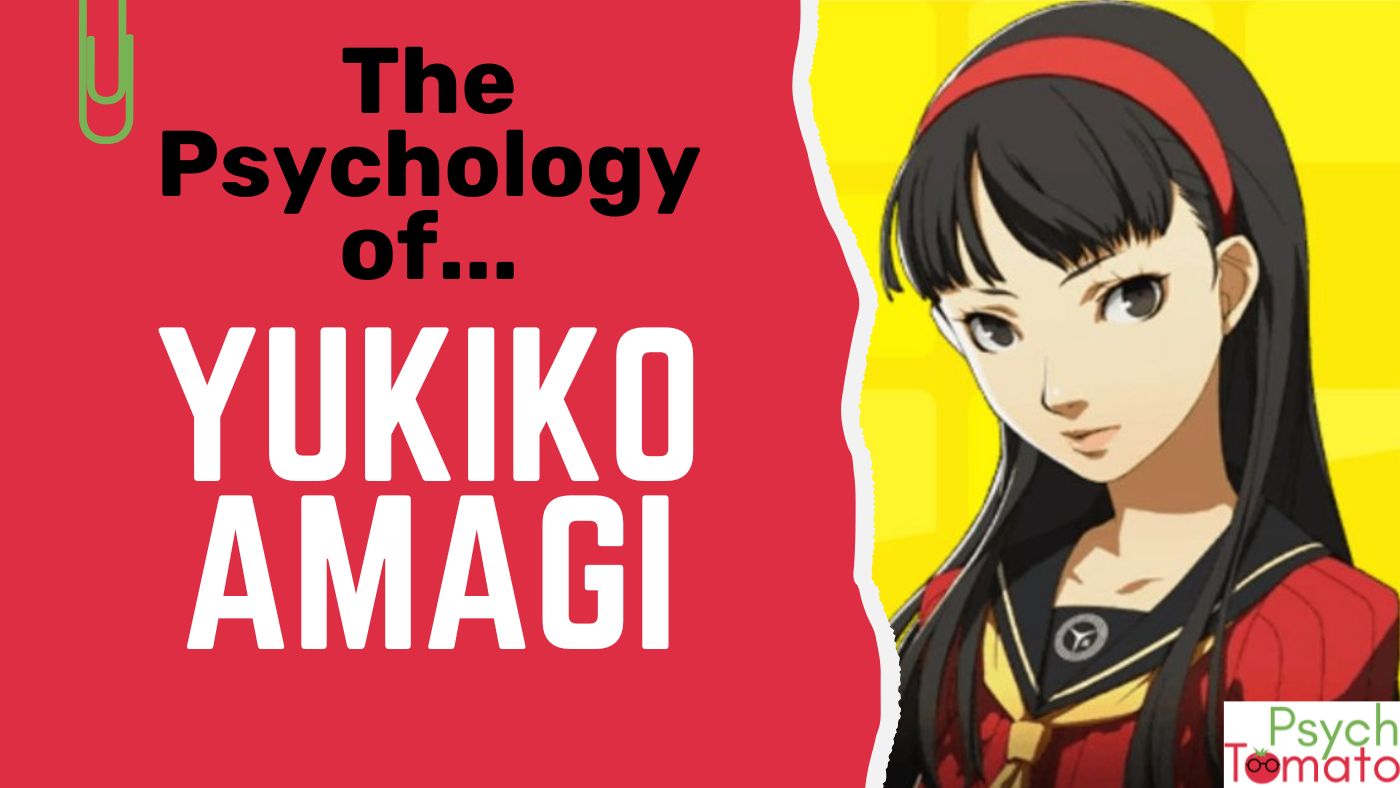
Yukiko Amagi has the sort of future adults usually call fortunate: a respected family business, a secure place in her community, and a life with the minor inconvenience of already having been decided for her.
Persona 4 understands the catch, though. A life can be objectively good and still feel like a cage when somebody else chose it, decorated it, and handed you the keys as a family obligation.
It’s exactly that contradiction that sits at the center of Yukiko Amagi’s personality. She is reserved, responsible, caring, intelligent, and, when the mood takes her, capable of laughing as though civilization has just been cancelled.
Beneath all that composure, however, lies a difficult question that Yukiko is trying to answer: Do I inherit the Amagi Inn because I want it, or because nobody ever imagined I might say no?
Yukiko’s arc isn’t simply about tradition versus freedom. While that’s part of it, when we look deeper we see that it’s more specifically about the nuances of turning an inherited future into a chosen commitment.
Before We Begin: A Quick Note
This article contains spoilers for Persona 4 and Persona 4 Golden, including Yukiko’s Midnight Channel dungeon and her Social Link. If you haven’t played the game and want to experience Yukiko’s journey firsthand, consider this your warning!
Also, remember: this is not a clinical analysis of Yukiko, and we’re not trying to diagnose her. After all, she’s a fictional character and not a patient who has consented to psychological assessment!
So, instead, we’re using Yukiko’s story as a lens to explore real psychological concepts.
We’ll use modern research where it fits and Jungian ideas where the game invites them. Just note that those are different tools, though. One provides empirically studied psychological frameworks while the other provides a symbolic way to interpret the story.
Meet the Character: Yukiko Amagi’s Personality at a Glance
Atlus’s official character profile describes Yukiko as a classmate whose parents own and manage the long-established Amagi Inn. She is training to take over the business, is close friends with Chie, and is both quick-witted and occasionally airheaded.
It might be easy to glaze past that last point, but the contradiction matters more than you might initially think. Yukiko isn’t the porcelain saint that her reputation suggests. She is a clever, conscientious teenager with an eccentric sense of humor and occasional difficulty reading the room.
Psychologically, her defining characteristics are:
- Public face: Polite, composed, dependable, and dutiful
- Private conflict: Resentment and anxiety about a future chosen for her
- Central psychological need: Autonomy, meaning a sense of authorship over her own life
- Strengths: Loyalty, responsibility, curiosity, and the ability to reconsider her assumptions
- Blind spot: She initially treats escape as the only possible proof of freedom
- Core tension: She genuinely loves people and traditions that also make her feel trapped
Her famous laughing fits are not evidence of a disorder or some kind of hidden diagnostic clue. They are important characterization! As the player, we see that beneath all of Yukiko’s immaculate manners and elegant reputation is still a gloriously silly teenager who sometimes finds something funny and loses the plot completely.
In other words, Yukiko’s public image is certainly real, but it is not the whole person!
The Life Everyone Chose for Her
The Amagi Inn isn’t simply where Yukiko lives and works. It’s a deeply respected family legacy, a local institution, and the future that everyone assumes she will someday inherit.
Nobody needs to issue some kind of theatrical threat for that assumption either. The expectation is already built into daily life! Yukiko is trained for the role, admired for fitting it, and discussed as though her succession were an approaching season rather than a possible decision to be determined.
That is what makes her conflict so difficult. The inn isn’t evil, and her family isn’t some collection of moustache-twirling tyrants. The inn’s staff genuinely care about her, the business matters to Inaba, and Yukiko deeply understands both the labor and history behind it.
That’s the funny thing about pressure, though, isn’t it? Pressure doesn’t always kick down the door screaming “do this OR ELSE!“ Sometimes it arrives in silk slippers and asks whether you’ve eaten today.
During her Social Link, Yukiko begins preparing for the possibility of leaving. She practices practical skills like cooking because she wants to know whether or not she could actually live independently.
The cooking is often hilariously disastrous, but that’s hardly the point. Yukiko is testing to see whether a life outside of the inn is genuinely possible for her. Before she can make a genuine choice, she needs to have more than one available option.
At first, however, freedom means only one thing to her: getting away.
That’s pretty understandable, though, right? After all, when one path has been imposed on you for years, choosing the opposite can feel like the only decision that is truly yours.
But the irony is that that opposition is still organized around somebody else’s expectations. If your entire identity is “not what they wanted,” they are still the one holding the map.
The Castle, the Princess, and the Caged Bird
Yukiko’s Midnight Channel dungeon turns her conflict into a fairy tale with all the subtlety of a flaming carriage.
Her Shadow appears as an exaggerated princess trapped in a castle, waiting for a prince to swoop in and carry her far away. The imagery eventually becomes even less discreet: a bird confined within a cage, desperate to escape.
The Shadow isn’t revealing that Yukiko is secretly shallow or helpless. The Shadows in Persona 4 are hostile caricatures that take disowned feelings, turn every dial to its absolute maximum, and then perform them under stage lighting.
Shadow Yukiko transforms a legitimate desire for agency into a rescue fantasy. She wants somebody else to remove her from Inaba because being rescued would spare her from making the decision herself and, therefore, from owning whatever pain that decision causes.
The uncomfortable truth here is not merely that Yukiko wants to leave. More specifically, it’s that part of her wants someone else to make leaving possible.
Looking at it through a Jungian lens1, Yukiko’s dutiful-heir identity resembles the public Persona, while her resentment, anger, and desire for escape have been pushed into the Shadow.
Now, note that accepting the Shadow doesn’t mean obeying it. It means admitting that these feelings belong to her, thus allowing her to examine them consciously.
That distinction is central to Jung’s idea of individuation. Individuation doesn’t mean becoming independent from everybody else. What it means is integrating the divided parts of the self into a more coherent “whole.”
So, for Yukiko, becoming whole requires making room for both truths:
- She resents having her future assumed.
- She genuinely cares about the inn and the people within it.
Maturity doesn’t demand that one truth murder the other.
Autonomy Is Not the Same as Leaving
The clearest modern framework for Yukiko’s story is Self-Determination Theory.
In their foundational review, psychologists Richard Ryan and Edward Deci described three basic psychological needs:2
- Autonomy: Experiencing your actions as willing and self-endorsed
- Competence: Feeling effective and capable of developing mastery
- Relatedness: Feeling meaningfully connected to other people
Now, note the crucial point that autonomy does not mean doing everything alone. It doesn’t require rebellion, separation, or moving to a dramatic apartment in the far-off big city where one owns a single chair and calls it liberation.
Autonomy means psychological ownership.
A person can freely choose responsibility, family connection, or even dependence on others. The question here is whether the action feels internally endorsed or externally controlled.
Progressing through the game, Yukiko’s Social Link wonderfully touches all three of these needs:
- She develops autonomy by treating departure as a real possibility.
- She develops competence by learning skills she would need outside the inn.
- She preserves relatedness through her friendships and her growing recognition of what the inn’s people mean to her.
Her eventual decision doesn’t maximize autonomy by sacrificing all of her relationships. Instead, it brings autonomy and relatedness into a far more workable arrangement.
Same inn. Different verb.
She moves from the feeling of “I have to stay” toward saying “I choose to stay.”
A Necessary Cultural Correction
Coming from a Western perspective, it would be tempting to explain Yukiko’s struggle by saying that Japan is collectivist and therefore places family duty above individuality.
However, it would also be a pretty lazy take…
After all, one fictional teenager from one supernatural rural town isn’t exactly a national survey, right? Broad cultural labels quickly become stereotypes, especially when “autonomy” is silently treated as another word for Western individualism.
A cross-cultural study by psychologist Valery Chirkov and colleagues explicitly separated autonomy from individualism and independence. Across samples from South Korea, Russia, Turkey, and the United States, more autonomous internalization of cultural practices was associated with well-being.3
Now, Japan wasn’t part of that study, so it shouldn’t be cited as proof of anything specifically Japanese.
However, the defensible conclusion is narrower and more useful: connection and autonomy are not opposites. A person can freely endorse family and cultural responsibilities without surrendering individuality.
That is precisely what makes Yukiko’s final choice psychologically plausible.
Identity Foreclosure: When the Answer Arrives Before the Question
Developmental psychologist James Marcia organized identity development around two processes: exploration and commitment.
From their different combinations came four identity statuses.4 The most relevant here is “foreclosure,” which (psychology admittedly being occasionally gifted at dreadful branding) means committing to an identity without first exploring meaningful alternatives.
Now, a family career is not inherently foreclosure, and nor is honoring tradition, for that matter. The issue is whether the commitment was examined and personally endorsed.
Yukiko’s original relationship with the inn resembles foreclosure:
- Her future is treated as settled.
- The role comes from family and community expectations.
- She has not seriously explored alternatives.
- Questioning the path feels selfish before it feels possible.
Her Social Link introduces exploration. We see how she imagines leaving, is working to develop practical skills, and tests the emotional meaning of life beyond the inn.
When she later chooses the inn, the outcome may look unchanged from the outside. However, the psychological process behind that decision is not.
In Marcia’s original identity-status framework, commitment following exploration is called identity achievement. These labels are not diagnoses or permanent ranks on some adolescent character sheet, but they do offer a useful interpretive distinction.
A path selected after credible alternatives have been considered is not psychologically identical to a path followed because questioning it felt forbidden.
The destination may be the same, but the ownership is totally different!
Chie, Relatedness, and the Myth of Solo Growth
Yukiko’s friendship with Chie Satonaka is essential to her story, but not because Chie is a flawless motivational coach with no shortage of kung-fu movie recommendations.
Early in the game, we quickly see that their friendship contains its own dependency.
Yukiko relies heavily on Chie’s boldness and decisiveness. Chie, meanwhile, draws part of her self-worth from being Yukiko’s protector. Chie’s Shadow exposes the less flattering side of that arrangement: being needed can feel uncomfortably similar to being superior.
That complication makes their friendship more interesting, not less valuable. We cover that in more detail in our dedicated look at the psychology of Chie, though.
Focusing back on Yukiko, close relationships can support autonomy when they give people enough safety to explore without demanding that they remain fixed in familiar roles. Yukiko needs room to become more decisive. Chie, meanwhile, needs to care for Yukiko without requiring Yukiko’s dependence.
By growing, Yukiko isn’t rejecting her friend. Instead, she is creating the possibility of a friendship between equals rather than a permanent arrangement between “rescued princess” and “designated prince.”
Does Yukiko’s Ending Betray Her Arc?
There is a fair criticism of Yukiko’s story that needs to be addressed head-on: after all that struggle, she still ultimately ends up choosing the future that everyone originally expected. Someone who didn’t see Yukiko’s story would be none the wiser!
Read cynically, the ending returns the rebellious daughter to her “proper place” and calls it character development.
Now, to be fair, that interpretation deserves consideration. The game doesn’t dismantle the inheritance system around Yukiko, nor does one personal realization make years and years of family pressure suddenly evaporate. We shouldn’t pretend that announcing a choice makes it somehow magically immune to influence.
But Yukiko does not remain because leaving proves impossible.
She prepares to go, learns that she could survive elsewhere, and gives serious attention to another future. In doing so, she discovers that her anger is not directed entirely at the inn. Much of it actually comes from being treated as though her consent were irrelevant.
Once her departure becomes possible, her staying can finally become meaningful.
Two people can perform the same action for very different reasons. One remains because guilt, fear, or pressure makes leaving unthinkable. Meanwhile, another remains after examining the alternatives and deciding that the responsibility reflects their values.
Behavior alone can’t tell us which is which.
Yukiko’s conclusion is therefore not a case of “family was right all along.” It is closer to: the life they expected may still be the life I want, but it becomes mine only after I am free to question it.
Sometimes freedom changes your address. Sometimes it changes who holds the pen.
Beyond Inaba: Chosen Duty Versus Inherited Duty
It’s pretty safe to say, I think, that most of us will never inherit a famous Japanese inn, battle an enormous caged bird, and/or summon Konohana Sakuya during a murder investigation.
The underlying conflict in Yukiko’s story, however, is considerably more common.
People inherit careers, family roles, religious identities, caregiving responsibilities, and reputations. Someone becomes “the dependable one,” “the future doctor,” or “the child who will take over the business” long before they get to decide whether or not the role actually fits.
In that light, Yukiko’s story offers several useful questions for us to reflect on:
- Have I chosen this role, or have I simply never imagined a credible alternative?
- Would I still want it if nobody praised me for staying or condemned me for leaving?
- Can I negotiate how I fulfill the responsibility?
- Would the people involved respect a genuine “no”?
- Am I staying because the commitment reflects my values, or because guilt has made every other option feel immoral?
Chosen duty isn’t a lesser form of freedom. After all, responsibility can provide a brilliant sense of belonging, purpose, and continuity.
But if “no” is truly impossible, then the “yes” isn’t fully yours.
Tomato Takeaway
Yukiko’s growth isn’t that she becomes independent enough to leave. More specifically, it’s that she becomes autonomous enough to stay.
At first, the Amagi Inn feels like a cage because her future appears closed. Her Shadow turns the wish for escape into an embarrassing spectacle, but it also forces her to admit that the wish exists.
Through exploration, growing competence, and more honest relationships, Yukiko transforms an inherited script into a chosen commitment.
There is no cinematic bridge-burning declaration or some kind of grand rejection of everything that came before. More practically (and, I’d even argue more powerfully), it’s just a young woman who is finally taking authorship of a sentence that everyone else had already written for her.
Sometimes that is what freedom looks like when it grows up.
But, as we wrap up, now it’s your turn to join the conversation!
Have you ever chosen a path that once felt imposed, but only after giving yourself permission to refuse it?
Share your thoughts in the comments! I’d love to hear how Yukiko’s story resonates with your own!
Sources and Further Reading
- Hopwood, A. (n.d.). Jung’s model of the psyche. The Society of Analytical Psychology. https://www.thesap.org.uk/articles-on-jungian-psychology-2/carl-gustav-jung/jungs-model-psyche/ ↩︎
- Ryan, R. M., & Deci, E. L. (2000). Self-determination theory and the facilitation of intrinsic motivation, social development, and well-being. American Psychologist, 55(1), 68–78. https://doi.org/10.1037/0003-066X.55.1.68 ↩︎
- Chirkov, V. I., Ryan, R. M., Kim, Y., & Kaplan, U. (2003). Differentiating autonomy from individualism and independence: A self-determination theory perspective on internalization of cultural orientations and well-being. Journal of Personality and Social Psychology, 84(1), 97–110. https://doi.org/10.1037/0022-3514.84.1.97 ↩︎
- Marcia, J. E. (1966). Development and validation of ego-identity status. Journal of Personality and Social Psychology, 3(5), 551–558. https://doi.org/10.1037/h0023281 ↩︎

Fueled by coffee and curiosity, Jeffrey is a veteran blogger with an MBA and a lifelong passion for psychology. Currently finishing an MS in Industrial-Organizational Psychology (and eyeing that PhD), he’s on a mission to make science-backed psychology fun, clear, and accessible for everyone. When he’s not busting myths or brewing up new articles, you’ll probably find him at the D&D table or hunting for his next great cup of coffee.