
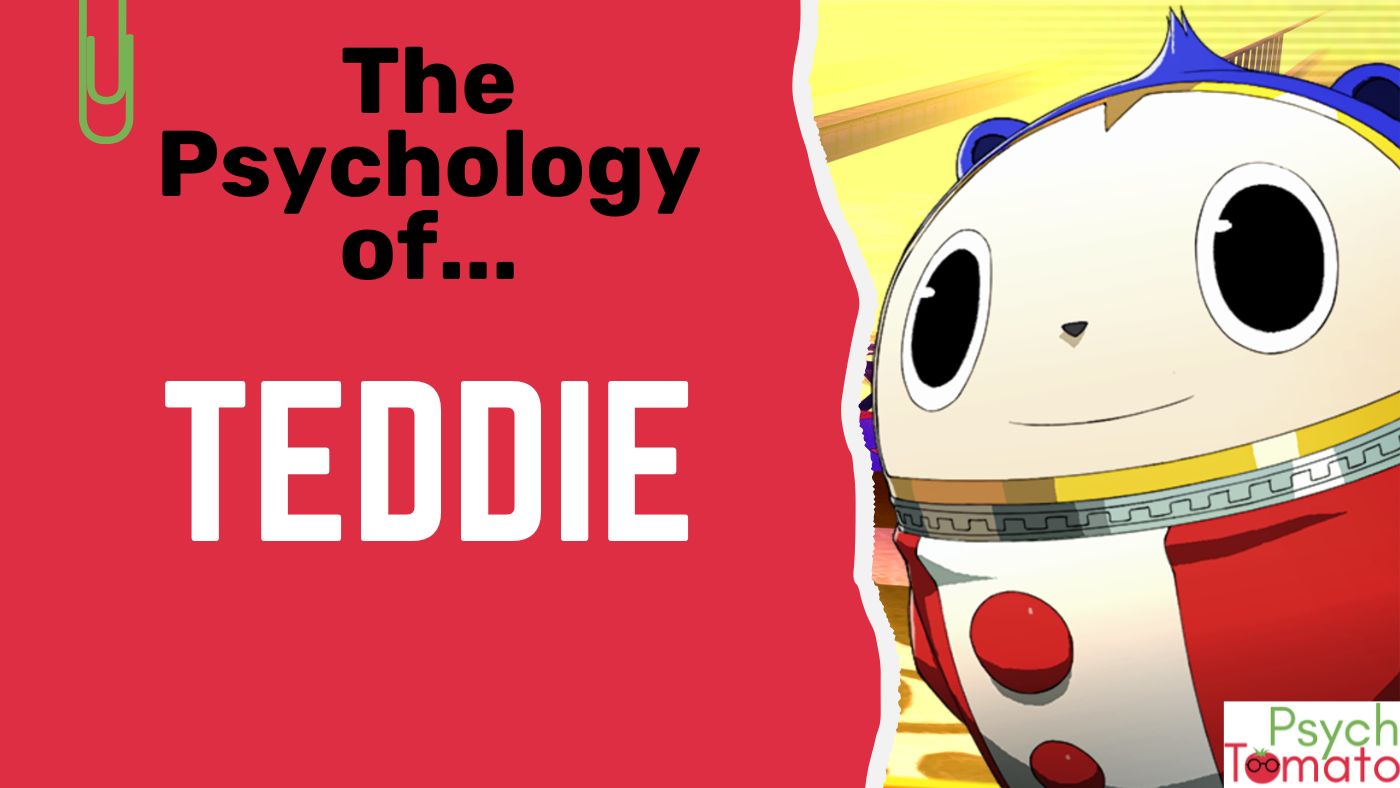
Most Persona 4 characters are terrified that there is something ugly inside them.
Teddie, on the other hand, faces an even ruder possibility: What if there is nothing inside him at all?
At first, that isn’t even a metaphor. He begins the game as a walking, talking bear costume with no body underneath. Unzip the mascot and, BOOM, find existentialism.
That is the heart of the psychology of Teddie. His story isn’t about uncovering one embarrassing secret buried beneath the mask. It’s about wondering whether the mask may be all there is and whether a person without a clear origin can still become someone real.
For all the bear puns, flirtation, and magnificent blond hair, Teddie’s journey actually asks one of Persona 4’s most serious questions: Do we discover who we are…or do we build that person together?
Before We Begin: A Quick Note
Heads up: this article contains major spoilers for Teddie’s identity, the events involving Nanako, and the later portions of Persona 4.
It is also worth pointing out that this is a psychological interpretation, not a clinical diagnosis. Teddie is a supernatural being living inside an empty bear suit, which places him some distance beyond the ordinary jurisdiction of the DSM…
Still, his fears are recognizably human (even if the creature having them technically isn’t).
Meet the Character: Teddie’s Personality at a Glance
Teddie is introduced as a mysterious resident of the TV World. He has no memory of where he came from, no apparent family, and no explanation for why he even exists.
What he does have, though, is a job.
He understands the TV World better than the Investigation Team, so he becomes their guide and navigator. He helps them locate people trapped inside, warns them about danger, and tries (often desperately) to prove that he belongs.
Beneath the comic performance, several important traits emerge:
- Public face: Playful, theatrical, flirtatious, excitable, and aggressively committed to bear-related wordplay.
- Hidden fear: That there is no authentic person beneath the costume.
- Initial identity: The Investigation Team’s guide and navigator.
- Deepest need: To feel wanted, not merely useful.
- Defensive habit: Turning uncertainty into jokes, attention-seeking, or exaggerated confidence.
- Greatest strength: His capacity for attachment, emotional growth, and genuine care.
- Major blind spot: His hunger for approval can make him ignore other people’s boundaries.
- Central conflict: If he doesn’t know what he is, how can he know who he is?
Teddie isn’t simply hiding an insecure self behind comedy, whether that’s bear-jokes or otherwise. At the beginning, he lacks enough information to construct a stable self at all.
An Empty Suit With a Self-Concept Problem
Psychologists use the term self-concept clarity to describe how clearly and confidently someone’s beliefs about themselves are defined, how internally consistent those beliefs feel, and how stable they remain over time.1
Teddie has… Well, he has almost none of this…
He doesn’t know his species, history, purpose, or place in the world. He can’t trace himself back through childhood memories or family relationships. I mean, heck, even his own body initially provides no useful answer! There is only an empty costume, a voice, and the bewildering fact that someone seems to be speaking from inside it.
So, Teddie reaches for the most available substitute for identity: usefulness.
He is the guide. He knows the TV World and the humans need him!
That role gives his life some structure, but it also makes his self-worth dangerously conditional. If Teddie matters because the team needs a navigator, what happens when Rise can perform that role better?
This is the problem with storing your entire identity inside a job. Sooner or later, somebody else learns the spreadsheet…
When Rise joins the team and becomes its navigator, Teddie eventually finds a new role in combat. Yet the transition exposes the instability underneath his cheerful performance. He doesn’t merely risk losing a task. He risks losing the only available answer to the question, “Why am I here?”
A role can stabilize a developing identity. It just makes a poor foundation for the entire thing.
Shadow Teddie and the Fear of Nothingness
Teddie’s crisis erupts immediately after the confrontation with Rise’s Shadow.
Like the other Shadows in Persona 4, Shadow Teddie resembles Carl Jung’s concept of the Shadow: the parts of ourselves we reject, deny, or cannot comfortably integrate.
The game takes plenty of liberties with Jung’s ideas, of course. For all of his contributions, it’s hard to believe that Jung didn’t leave behind extensive clinical notes on murderous television bears. (Okay, okay, so maybe it’s not that hard to believe…)
Most members of the Investigation Team fear that their Shadows reveal something shameful inside them. Teddie’s Shadow argues that there is no meaningful self inside him at all.
There is no hidden truth… No solid identity… Absolutely no reassuring answer waiting beneath the costume…
Only… emptiness…
It is important, however, not to treat a Shadow as an infallible psychological oracle. Shadows take a real fear and present it as the whole truth. They speak with the confidence of a drunk at closing time: loudly, absolutely, and with very little interest in nuance.
Teddie initially rejects his Shadow because he cannot bear the possibility it represents. Yet eventually accepting it doesn’t give him a neat explanation of his origin either. He still doesn’t know precisely what he is.
What changes, though, is his relationship with that uncertainty.
Teddie acknowledges that he is frightened, that he lacks answers, and that he still wants to remain with his friends. His Persona emerges not because the mystery has been solved, but because he can finally face the question without letting its bleakest possible answer consume him.
That is a more mature form of self-acceptance than simply discovering a label.
Sometimes growth means finding the answer. Other times (perhaps more often and more frustratingly than we would prefer), it means becoming strong enough to live honestly while the answer is still missing.
The “True Self” Trap
Teddie’s crisis becomes clearer when compared with Rise Kujikawa’s own struggle with identity.
Rise worries that her public identities (idol, performer, cheerful celebrity) may have swallowed whatever authentic self existed beneath them. Her Shadow insists that the performed versions are false and that some concealed “real Rise” must be found underneath.
Rise ultimately recognizes that none of her roles contains her entire identity, but that doesn’t necessarily make those roles fake. Risette, the exhausted teenager, the flirt, the performer, and the frightened girl are all parts of one complicated person.
Teddie hears that same basic idea and then takes it somewhere far, FAR darker.
If there is no single, pure “real me” hidden underneath every role, he wonders, perhaps there is no self at all.
This is the philosophical trap at the center of his story. The alternative to one permanent inner essence isn’t necessarily emptiness. A person can possess multiple roles, changing qualities, contradictory feelings, and an unfinished history while still maintaining continuity through memory, relationships, values, and choices.
It’s easy to think of identity as some kind of fossil buried deep inside of us that’s just sitting there waiting to be excavated intact. However, it can also be a pattern that we continue creating throughout our lives!
Narrative Identity: A Story Without a Beginning
Psychologist Dan McAdams proposed that people create unity and purpose by forming an internalized, evolving story about their lives. This narrative identity connects remembered history, present circumstances, and imagined futures into some version of “the person I have been and am becoming.”2
Teddie’s problem is that his story appears to begin in the middle.
He has no remembered opening chapter. He cannot explain where he came from or why he developed awareness. That missing history makes his identity feel fraudulent, as though a story without a beginning can’t be real.
But narrative identity isn’t merely a factual record, mind you. It is also an interpretation.
We see as Teddie gradually constructs a story from the experiences available to him.
He helped the Investigation Team enter the TV World. He developed friendships. He confronted his Shadow. He chose to fight. He became attached to Nanako. He discovered pleasures, responsibilities, jealousies, embarrassments, and consequences… How’s that for a busy bear?!
Now, those experiences don’t erase the mystery of his origin, but they do give him something equally important: continuity.
When Teddie eventually remembers what he is, the revelation doesn’t replace this developing story. It instead becomes another chapter he must incorporate into it.
There’s a lesson there, right? An origin can explain part of a person without owning the entire narrative!
Bear-y inspirational, indeed!
A Human Body Does Not Make Him Real
After awakening to his Persona, Teddie eventually develops a human body inside the bear suit.
The human form arrives like existentialism with excellent conditioner.
This form allows him to participate in the ordinary world more fully. He can work at Junes, spend time with the group outside the TV World, wear clothing, attend social events, and attract considerably more attention than anyone was prepared to give him.
But his transformation creates an uncomfortable interpretive risk.
If Teddie becomes “real” only after acquiring an attractive human body, then the story’s message isn’t especially profound, is it? It would merely suggest that personhood is something awarded to whatever looks sufficiently human.
Fortunately, the broader arc gives us reasons to resist that reading.
The Investigation Team forms a relationship with Teddie while he is still an empty bear suit. He develops emotions, makes decisions, accepts responsibility, and awakens to a Persona before growing a human body. Yet, even afterward, the bear form remains a central part of how he expresses himself.
His human appearance expands the ways he can move through society, but it still doesn’t create the self who wanted those experiences.
The body is more like an addition to Teddie’s identity, not necessarily a certificate proving that he finally “deserves” one.
The Investigation Team as a Social Mirror
A large body of psychological research supports the idea that people are strongly motivated to form lasting interpersonal bonds characterized by recurring interaction and ongoing care.3
Teddie certainly wants companionship, but his connection to the Investigation Team does more than alleviate his loneliness. The group gives him a social environment in which an identity can actually develop.
As social identity theory suggests, part of our understanding of “me” emerges through the groups that become “us.” Group membership supplies roles, values, comparisons, expectations, and a sense of shared fate.
Teddie learns who he is partly through being one of them.
His relationship with Yosuke Hanamura is especially messy. Yosuke teases him mercilessly, but also gives him access to the ordinary world, helps him find a place at Junes, and treats him like someone whose presence must be accommodated rather than explained away.
Now, to be perfectly fair here, the teasing should certainly not be romanticized. Cruelty doesn’t become affection merely because the people involved remain friends. Still, their relationship contains something Teddie has never possessed before: history.
Rise, meanwhile, presents a different kind of mirror. She takes over his original role as navigator, thus proving that his place in the group cannot depend entirely on being indispensable. Of course, it helps that she also deeply understands the confusion created by performing different selves for different audiences.
The group doesn’t manufacture Teddie from nothing. It gives him the safety, resistance, recognition, and feedback through which his existing capacities can become organized into a more coherent person.
We learn something about ourselves when people need us. However, we may learn considerably more when they no longer need our particular function and yet still choose to keep us around anyway!
Humor, Flirting, and the Need to Be Seen
Research on humor styles distinguishes between humor used to strengthen relationships, humor used to maintain perspective during hardship, humor directed against others, and humor that gains approval at one’s own expense.4
Throughout the game’s plot, Teddie actually manages to dabble in nearly all of them.
His puns are often affiliative. They turn him into the group’s entertainer and give other characters an easy way to engage with him. For example, if everyone groans at the same bear pun, he has at least created a shared experience.
His theatrical confidence can also conceal uncertainty. Teddie often behaves as though attention itself will prove that he matters. Behaviors like flirting, exaggeration, and generally creating a spectacle allow him to test whether people will respond.
But attention proves visibility. It does not, however, guarantee belonging.
This is where Teddie’s behavior becomes… decidedly less charming… His flirting frequently wildly ignores obvious discomfort and personal boundaries, particularly with the girls in the group. Social inexperience and insecurity help explain why he behaves this way, but in no way do they excuse it.
A wound can explain a behavior without appointing itself as the behavior’s defense attorney.
Teddie must learn that connection requires recognizing other people as full persons, not simply as audiences capable of validating him. His desire to be seen is certainly understandable. With that said, though, his responsibility is to develop ways of pursuing that desire without treating somebody else’s discomfort as part of the joke.
That distinction matters outside the TV World as well.
Humor can invite intimacy, soften fear, and make difficult experiences bearable. That’s good! However, it can also become a smoke bomb tossed whenever sincerity or accountability enters the room.
The useful question here isn’t, “Am I funny?” When we really get down to brass tacks, it’s more like, “What is my humor trying to make possible and who is paying for it?”
Nanako and the Collapse of Conditional Worth
Teddie’s bond with Nanako is especially important because she offers uncomplicated acceptance.
Nanako’s story is already deeply connected to themes of loneliness, care, and the need for reliable attachment. With Teddie, she doesn’t demand an explanation of what he is. To her, he’s the funny bear from Junes, a friend, and part of the widening circle around her family.
When Nanako appears to die, Teddie’s developing identity collapses.
He believes he failed to protect someone he loved. His usefulness (the foundation upon which he originally built his entire right to belong) now seems totally disproven.
And so he retreats to the TV World, where the truth about his origin finally returns to him, and he remembers that he’s a Shadow.
That revelation confirms his oldest fear in one sense. There was no ordinary human, animal, or familiar creature hidden inside the suit. He emerged from the same strange world as the beings the Investigation Team has been fighting this whole time.
Yet this knowledge doesn’t erase the relationships he formed.
Nanako recovers. His friends want him to return. Crucially, they already have another navigator. They do not need the old function he once performed. They want Teddie.
That’s the difference between being useful and being loved.
Usefulness says, “You have earned your place because you provide something.”
Love says, “Your presence has become part of our lives.”
Teddie needs both purpose and connection, as most people do. His mistake was assuming that only the first could justify his existence.
What Makes Teddie “Real”?
Learning that Teddie is a Shadow gives him a category, but categories are not biographies.
The Investigation Team doesn’t deny his origin. They accept it and place it alongside everything else they know about him. Teddie has developed an ego, formed attachments, made choices, experienced remorse, and awakened to a Persona. Whatever Shadows ordinarily are, we and the team clearly see that Teddie has become capable of reflecting upon and directing his own behavior.
The contrast with Tohru Adachi then makes this point even sharper.
Teddie begins outside humanity and repeatedly moves toward care, connection, and responsibility. Adachi possesses a human body, a personal history, a respectable social role, and all the conventional credentials that Teddie lacks, yet he chooses a path of contempt, isolation, and harm.
Now, note that this is an interpretation rather than a rule stated by the game, but the contrast here is pretty difficult to ignore: being human is not the same thing as behaving humanely.
Persona 4 therefore seems less interested in identifying the correct substance from which a person must be made than in examining the qualities through which personhood becomes recognizable.
Continuity matters. Agency matters. Relationships matter. The ability to care, reflect, change, and accept responsibility matters.
Teddie’s origin sets the conditions from which his life begins, but it doesn’t dictate what he must become. The origin isn’t the verdict!
Meaning Comes in Three Parts
Psychologists Frank Martela and Michael Steger have argued that “meaning in life” becomes clearer when divided into three related components: coherence, purpose, and significance.5
Teddie’s arc touches on all three of those:
- Coherence concerns whether life makes sense. Teddie wants to understand what he is, where he came from, and how the pieces of his existence fit together.
- Purpose concerns direction and worthwhile goals. He finds direction by helping the Investigation Team, protecting people, and choosing how he will relate to both worlds.
- Significance concerns whether one’s life feels valuable and worth living. Teddie develops this through relationships that continue even when he is frightened, inconvenient, or no longer essential to the job.
Note that these are dimensions of meaning, not three levels of an existential staircase. A person can possess strong purpose while lacking coherence. They may know exactly what they are doing every day and still wonder whether any of it matters.
That is where Teddie begins.
His work as navigator gives him purpose, but little coherence and fragile significance. Discovering his origin improves coherence, but initially threatens his sense of worth. His relationships then ultimately allow the three pieces to coexist.
He learns what he is, chooses what he will do, and discovers that his life matters to people who know the truth.
Does Teddie’s Story Actually Work?
For all its psychological richness, Teddie’s arc isn’t flawless.
The arrival of his human body risks implying that becoming more recognizably human is a form of improvement. Much of his new social access (and plenty of the game’s comedy) depends on his transformation into an attractive blond teenager.
It’s also worth pointing out that much of the flirtation has aged less like wine and more like milk left in the Junes parking lot… The game too often treats ignored boundaries as “harmless comedy,” particularly when Teddie is directing his attention toward the female characters.
His identity crisis gives us the context for that behavior, but it doesn’t make every gag funny.
The late revelation about his Shadow origin also arrives relatively quickly, considering its enormous implications. A character discovering that he belongs to the same category as the monsters he has helped fight could support an entire story by itself.
Nevertheless, the broader arc does resist its worst possible interpretation.
Teddie is accepted before developing a human body, remains Teddie while wearing the bear suit, and continues to be accepted even after his friends learn that he is a Shadow. Having a human appearance gives him another way to experience the world, but it doesn’t replace the identity he formed beforehand.
The execution may wobble, but the underlying idea that personhood doesn’t depend on passing a visual inspection remains powerful.
Beyond the TV World: Identity When the Old Answer Stops Working
It seems like a pretty safe bet to say that most people will never discover that they are actually sentient Shadows living inside bear costumes.
Still, many people experience a less theatrical version of Teddie’s problem.
A career ends. A relationship changes. Children grow up. An injury removes an ability that once defined us. A family revelation disrupts the story we believed about our past. The role of “gifted child,” “provider,” “caregiver,” “athlete,” or “reliable one” suddenly just stops working one day…
When that happens, the frightening question isn’t merely, “What should I do next?” It’s usually much scarier than that when the question becomes something more along the lines of “Who am I if I cannot keep being that person?”
Teddie’s story isn’t suggesting that origins and circumstances are irrelevant. He did not choose where he came from, and the truth profoundly affects him.
But origins are materials, not marching orders.
We inherit bodies, histories, labels, relationships, opportunities, and limitations that we didn’t design. Self-authorship happens through what we make with those materials, not through pretending they were never there.
Teddie’s journey leaves us with several useful, though intense, questions:
- Which parts of my identity describe where I came from, and which describe what I am choosing?
- Who allows me to experiment with new roles without demanding that I perform perfectly?
- If the role that makes me useful disappeared, what relationships and values would remain?
- Is my humor helping me connect, or helping me hide?
- Have I confused not having a final answer with having no self at all?
Identity is less like a treasure buried at the bottom of a cave and more like a home built while we are already living in it.
There will certainly be renovations. Some rooms will likely turn out to be structurally unsound. The odds are high that at least one previous owner made some truly baffling choices with the wallpaper.
But… you know what… it’s okay! Unfinished is not the same thing as empty.
Tomato Takeaway
Teddie begins Persona 4 fearing that there is no real person beneath his costume.
What he eventually discovers is not a hidden, permanent essence waiting to explain everything. Instead, he discovers a history that he never chose, relationships he wants to preserve, mistakes he must own, and commitments capable of guiding what comes next.
His self isn’t a secret object stored inside the suit. It’s the pattern created across all of his many choices, attachments, memories, responsibilities, and hopes.
But as we wrap up, now I’d like to hear from you with today’s Tomato Takeaway!
If the role that currently makes you useful disappeared tomorrow, what would still make you you?
Share your thoughts in the comments below!
Sources and Further Reading
- Campbell, J. D., Trapnell, P. D., Heine, S. J., Katz, I. M., Lavallee, L. F., & Lehman, D. R. (1996). Self-concept clarity: Measurement, personality correlates, and cultural boundaries. Journal of Personality and Social Psychology, 70(1), 141–156. https://doi.org/10.1037/0022-3514.70.1.141 ↩︎
- McAdams, D. P. (2001). The psychology of life stories. Review of General Psychology, 5(2), 100–122. https://doi.org/10.1037/1089-2680.5.2.100 ↩︎
- Baumeister, R. F., & Leary, M. R. (1995). The need to belong: Desire for interpersonal attachments as a fundamental human motivation. Psychological Bulletin, 117(3), 497–529. https://doi.org/10.1037/0033-2909.117.3.497 ↩︎
- Martin, R. A., Puhlik-Doris, P., Larsen, G., Gray, J., & Weir, K. (2003). Individual differences in uses of humor and their relation to psychological well-being: Development of the Humor Styles Questionnaire. Journal of Research in Personality, 37(1), 48–75. https://doi.org/10.1016/S0092-6566(02)00534-2 ↩︎
- Martela, F., & Steger, M. F. (2016). The three meanings of meaning in life: Distinguishing coherence, purpose, and significance. The Journal of Positive Psychology, 11(5), 531–545. https://doi.org/10.1080/17439760.2015.1137623 ↩︎

Fueled by coffee and curiosity, Jeffrey is a veteran blogger with an MBA and a lifelong passion for psychology. Currently finishing an MS in Industrial-Organizational Psychology (and eyeing that PhD), he’s on a mission to make science-backed psychology fun, clear, and accessible for everyone. When he’s not busting myths or brewing up new articles, you’ll probably find him at the D&D table or hunting for his next great cup of coffee.