
My interest in workplace wellbeing began long before academia, back when I was working in corporate environments and noticing a subtle but peculiar pattern: employees tend to mirror their bosses’ behavior.
If a manager proudly used the company gym or attended wellness workshops, suddenly those benefits became “the thing to do.” If, on the other hand, a manager treated breaks like a moral failure and fitness as a waste of time… well, teams followed that lead too.
In other words: culture isn’t what’s written in the HR handbook; it’s what your boss does at 2:00 PM on a Tuesday.
And yes, sometimes that culture includes expectations to answer emails and phone calls while allegedly “on vacation.”
One of my favorite managers took his team out for team-building activities, including bowling, mini golf, and volleyball practice. We had a great time socializing and getting to know each other better, including discovering who was the most competitive and who was the most physically fit. There was no judgment, just a lot of fun and camaraderie.
Later, I encouraged another manager and some of my direct reports to take walks around the building instead of holding one-on-one meetings in stuffy offices. The walks created a more relaxed atmosphere and often led to better conversations and stronger connections.
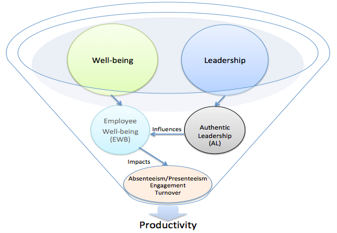
These experiences inspired my doctoral research on “leadership influence in employee wellness and organizational productivity.” Using Employee Wellbeing Theory and Authentic Leadership Theory (Figure 1), I explored how leadership behaviors shape employee engagement, satisfaction, and health outcomes.
The findings were consistent and compelling:
When employees believe their leaders genuinely care about their well-being, engagement and job satisfaction increase significantly.
In one organization I studied, 93% of employees felt leadership supported their health compared to a national benchmark of 9.3% at the time. Not coincidentally, this company was consistently ranked among the best places to work in the U.S.
Engagement in 2026: Not Exactly Thriving
If we fast-forward to today, the need for strong leadership influence is even clearer.
- Only 31% of U.S. employees are engaged at work (a 10-year low) (Harter, 2025)
- Globally, engagement dropped to 21% in 2024 (Gallup, 2025)
- Disengagement now costs the global economy up to $8.8 trillion annually (Dennison, 2024)
In short: disengagement isn’t just an HR issue but an economic one.
Wellness, Productivity, and the “Quiet Middle”
Employees who feel physically and mentally well are more productive, less likely to be absent (or present but exhausted), and more resilient to stress.
Absenteeism is visible and measurable, and presenteeism is quieter, but often more expensive. Think about that employee who shows up but is always running low on caffeine. Not exactly peak performance.
Organizations today are navigating increased stress, hybrid work complexity, and post-pandemic recalibration of priorities. Many employees didn’t just leave during the “Great Resignation” in 2021; others stayed but disengaged quietly.
To address these concerns, most companies offer some wellness programs or benefits (about 85% do), but only 30–35% of employees actually use them (Felman, 2026).
Why the gap?
Because wellness programs without leadership support are like treadmills being used as garment racks: they exist, but they’re not serving their intended purpose.
Common pitfalls include:
- Lack of leadership participation in programs
- Poor communication of health benefits
- Managers modeling burnout instead of balance
In real life, employees pay attention to what leaders do, not just what they email.
My research found a strong correlation between leadership participation and employee participation in wellness initiatives.
Three key drivers stood out:
- Visibility – Employees notice when leaders participate (yes, even CEOs were logging in their steps on tracking apps).
- Social signaling – “If my manager prioritizes health, maybe I can too without career risk.”
- Incentives – Financial rewards for wellness programs help, but leadership modeling sustains behavior.
For example, one organization increased participation from 17% to 57% after aligning incentives and leadership involvement.
So, while incentives might get people enrolled in wellness programs, leadership behavior keeps them actively involved.
Other Secret Ingredients: Authentic Leadership + Flexible Work
Authentic leadership (characterized by empathy, transparency, and consistency) plays a powerful role in reducing burnout and improving engagement.
Employees are more likely to thrive when leaders:
- listen without judgment
- communicate clearly
- demonstrate genuine care
Conversely, autocratic or micromanaging leadership styles tend to produce stress, lower morale, and, unsurprisingly, less enthusiasm for optional wellness activities.
After all, nothing says “join the mindfulness session” like a manager who emails you during it.
Speaking of mindfulness, my doctoral research on the benefits of meditation and yoga inspired me to become more deeply engaged in both practices. What began as an area of academic interest soon became a personal passion, leading me to earn my certification as a yoga teacher.
Today, I continue to share that passion by teaching yoga, meditation, and Pilates classes at a local wellness center.
Flexible work arrangements (whether hybrid, remote, or compressed schedules) have become essential drivers of wellbeing and engagement.
Research consistently shows that flexibility:
- improves morale
- reduces turnover
- increases perceived organizational support
Translation: giving people control over their time often leads to better use of it.
So, What Does This Actually Look Like In Practice?
Leaders’ “modeling behavior” simply means that people on a team learn what is normal and acceptable by watching what the leader actually does.
In everyday terms, employees pay more attention to patterns than policies. So if a manager says, “We value work-life balance,” but consistently sends late-night emails or praises people for skipping breaks, the real message becomes: overwork is expected here. That mismatch quietly shapes culture far more than any wellness initiative or HR training.
One of the most visible ways leaders model behavior is through daily habits and responses to pressure.
When leaders take lunch breaks, log off at reasonable times, and use vacation without apology, they signal that rest is part of performance, not a reward for overwork. Likewise, when they respond to stress by prioritizing, setting boundaries, and managing workload realistically, they teach teams that sustainability is part of effective work.
In contrast, when leaders glorify exhaustion, reward last-minute heroics, or remain constantly “on,” employees often internalize burnout as the standard for success.
Burnout is not unique to U.S. organizations.
In Japan, the widely documented phenomenon of karoshi (death from overwork) showed that extreme workplace pressure, in severe cases, has led to fatal cardiovascular events among employees, often including younger workers (Gilbreath, 2012). These cases illustrate how organizational norms that implicitly reward overwork can escalate from cultural expectation to serious health risk.
At the core, modeling sustainable behavior is less about being perfect and more about being consistent. Employees don’t expect flawless leaders, but they do closely watch what behaviors are repeated, rewarded, or ignored.
When leaders align their actions with the message that well-being matters as much as productivity, they create a culture where healthy work habits become the norm rather than the exception.
Final Thoughts
- Employees don’t leave companies; they often leave “toxic” managers.
- People now evaluate jobs based on the impact on their well-being, not just salary.
- Organizations that ignore wellness culture risk losing both talent and productivity.
The takeaway is simple (though not always easy): Leaders don’t need to become marathon runners or fitness instructors, but they do need to model sustainable work behaviors.
Whether they intend to or not, employees are always watching. And if your team sees you skipping lunch, answering emails at midnight, and calling that “balance”… they’ll learn that lesson faster than any training program can teach.
Well-being starts at the top.

Irina Zlatogorova-Shulman, Ph.D.
Dr. Irina Zlatogorova-Shulman, or Dr. Z, as some students call her, is a professor of business psychology and organizational leadership at Southern New Hampshire University (SNHU) and The Chicago School of Professional Psychology (TCSPP). Originally from Russia, she immigrated to the United States in 1992. Dr. Z holds a Ph.D. in Business Administration from Northcentral University, with a specialization in Industrial-Organizational Psychology.
Before transitioning into academia, she spent over 20 years in executive leadership roles across business and consulting. For the past eight years, she has dedicated her work to teaching, research, and mentoring Ph.D. students. Her primary passion lies in exploring and advancing employee wellbeing and healthy organizational cultures.
I appreciate your insight. Your article gave me a new perspective on the habits of a coworker I genuinely enjoy spending time with. They regularly encouraged several of us to take lunch together and go for walks—not rigorous hikes, but simple walks around a nearby park when the weather was nice or a stroll through the Houston Galleria, sometimes just to window shop and check out the latest Apple innovations.
Reading your article helped me realize those moments were about more than just getting out of the office. They strengthened relationships, built a stronger professional network, and created opportunities for conversations that probably wouldn’t have happened sitting around a conference table.
As someone who knows I should be doing more for my own health, your article also gave me a perspective I hadn’t considered before. Physical activity doesn’t just contribute to personal well-being; it can also foster professional growth and stronger workplace connections. Thank you for sharing your research and insights.