
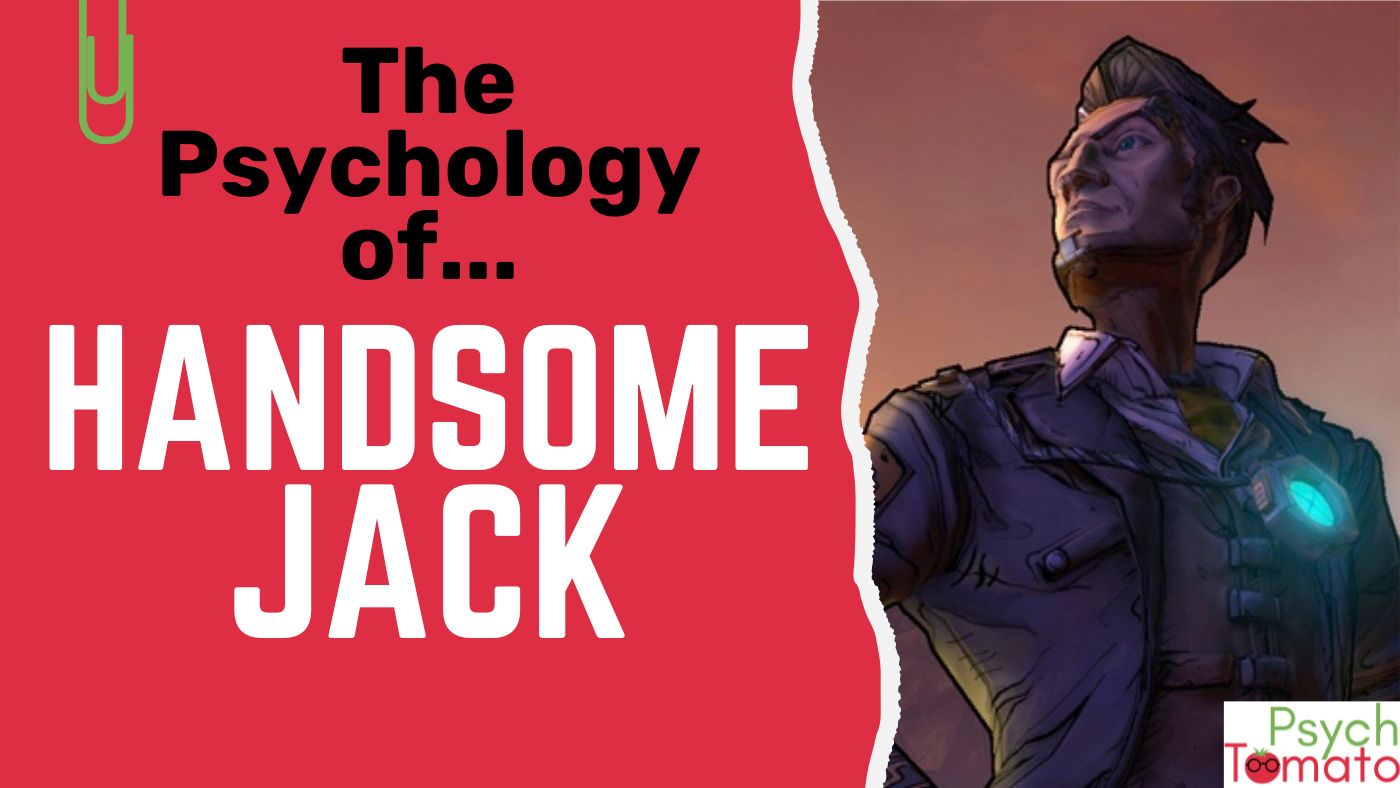
I’ve recently been revisiting one of my favorite game series, Borderlands, for the first time in several years.
Reexperiencing the games, somewhere between all of the bullets, explosions, and laugh-out-loud moments, I got a message in my head from… let’s just call her a “Guardian Angel”… that said it’s time to give the series’ most iconic character the full PsychTomato treatment…
Handsome Jack is the kind of man who can build an entire city as a monument to himself and still insist that the project is fundamentally about public service.
The city of Opportunity has his face plastered everywhere. Hyperion broadcasts his worldview at industrial volume while statues celebrate his greatness, propaganda praises his leadership, and somewhere nearby, a loader bot is presumably filing paperwork explaining why the latest massacre was actually a community-improvement initiative.
More unsettlingly, Jack may genuinely believe it.
Of course, he lies… like… all the time… He regularly manipulates people, rewrites history, and totally changes explanations the second that the previous one stops being useful.
However, the central lie of his life isn’t necessarily cynical. Jack truly seems to experience himself as the hero.
In his mind, he is the brilliant visionary bringing much-needed order to Pandora. He’s also the loving and long-suffering father protecting a dangerous daughter. Out of sheer necessity, he is the betrayed idealist who is forced to make the difficult decisions. Perhaps most of all, he is the only responsible adult in a universe that’s positively overflowing with bandits, idiots, and people who have somehow failed to recognize his obvious magnificence.
At least, that’s the version of the story playing inside Jack’s head…
That contradiction sits right at the center of Handsome Jack’s psychology. He doesn’t commit his numerous atrocities because he believes morality is meaningless. He commits them because he has constructed a version of morality in which almost anything becomes acceptable when he does it.
So, that begs an important question, doesn’t it? After all, what happens when being “the good guy” stops functioning as a standard for our behavior and instead becomes an identity we must protect at any cost?
Well… in a nutshell… Pandora happens.
Before We Begin: A Quick Note
As a heads up, this article is going to be much longer than the usual character analyses on this site. There’s an absolute ton to cover if we’re going to do it justice (and, as I said, I’ve kind of been hyperfixating on my replay through the series, so that’s also a bit to blame here…)
Additionally, be aware that this analysis contains some major spoilers for Borderlands, Borderlands 2, Borderlands: The Pre-Sequel, Tales from the Borderlands, and the “Childhood’s End” mission in Borderlands 3.
If you haven’t yet experienced Handsome Jack’s rise, fall, death, digital resurrection, second fall, and surprisingly durable commitment to personal branding, consider this your warning.
Last but not least, it’s also important to clarify right up front that this is a psychological interpretation, not a clinical diagnosis. We can use real psychological research to examine and discuss Jack’s traits, decisions, relationships, and leadership, but we cannot determine that he has a particular mental disorder.
After all, Jack is made of dialogue, animation, and enough corporate propaganda to make even LinkedIn uncomfortable. He’s not a patient who has consented to assessment!
With that all covered, though, let’s dive in!
Meet the Character: Handsome Jack’s Personality at a Glance
When we first encounter Handsome Jack in Borderlands 2, he’s the president of the Hyperion Corporation and the self-appointed “savior of Pandora.”
He has seized control of the planet, built armies of loader bots, massively devastated entire communities, and plans to awaken The Warrior so he can eliminate anyone he classifies as a bandit (which is, to say, basically everyone on Pandora).
Right in the game’s opening cutscene, Jack’s welcome to the new Vault Hunters involves luring them onto a train and promptly blowing it up.
You know… standard executive onboarding type stuff…
Despite all of this, Jack rarely sounds like a distant or humorless dictator. He’s casual, funny, quick-witted, and strangely personable in his own unique way. Again, right from the start, he’s speaking to the Vault Hunters constantly, mocking their progress, telling stories, offering commentary, and generally behaving as though everyone involved is participating in an amusing workplace rivalry.
Beneath that performance, though, several defining characteristics emerge:
- Public face: Charming, funny, confident, informal, and apparently unshakable
- Core self-story: He is Pandora’s misunderstood hero and rightful savior
- Central psychological need: To have his exceptionalism recognized and his authority confirmed
- Primary emotional trigger: Humiliation, betrayal, or loss of control
- Defensive habit: Ridiculing, blaming, dehumanizing, or rewriting anyone who contradicts him
- Interpersonal pattern: Other people are audiences, instruments, or extensions of himself until they demonstrate independent needs
- Greatest strengths: Intelligence, charisma, ambition, strategic daring, and persistence
- Greatest blind spot: He mistakes certainty for morality and control for care
- Central contradiction: He desperately wants to be recognized as a “hero” but cannot allow anyone else enough moral authority to judge his behavior
Jack’s problem isn’t quite that he has no conscience. More specifically, it’s that he has reorganized the entire moral universe until his conscience always agrees with him.
That’s an important distinction to keep in mind as we continue delving deeper.
The Hero Who Can’t Be Corrected
Psychologists use the term “narrative identity” to describe the evolving story people construct to connect their past, present, and imagined future into a meaningful sense of who they are.1
Now, it’s important to note that these personal stories aren’t perfectly objective documentaries. Far from it, actually!
We select memories, emphasize certain experiences, assign motives, identify turning points, and interpret what our suffering means.
That doesn’t necessarily make narrative identity dishonest, mind you. It’s simply one of the ways that humans create continuity from the sprawling collection of things that happen to us.
Handsome Jack’s narrative casts him as several heroic figures at once:
- The overlooked genius whose talent exceeds his position
- The visionary who sees possibilities that more timid people simply cannot
- The father protecting the world from his daughter’s dangerous powers (and her from the world, for that matter)
- The civilizing force trying to bring order to a lawless planet
- The wounded idealist who is constantly betrayed by the people he trusted
- The hero willing to make the sacrifices that weaker people avoid
Importantly, this isn’t just a flattering story Jack tells other people.
Back in 2013, Borderlands 2 writer Anthony Burch actually explained that Jack believes he had legitimate reasons for imprisoning Angel and using her powers. In Jack’s mind, he was protecting his daughter, making the world better, and eventually becoming the protagonist of a revenge story after she died.2
That gives us an important distinction that we have to keep in mind if we’re going to understand Handsome Jack.
Jack may know that certain individual statements are false. He may hide information, manipulate events, and invent excuses with considerable skill. However, those smaller lies protect a larger belief that he experiences as true: I am the good guy.
The problem isn’t that Jack has a story about himself. After all, we all do!
It’s that his story has no mechanism for revision.
If people oppose him, they’re just proving how dangerous Pandora is. If allies betray him, they prove that trust is weakness. If his actions kill innocent people, those people must have been bandits, collaborators, or unfortunate but necessary sacrifices, right? If Angel resists him, it’s because she simply doesn’t understand what’s best for her.
And, as we see at the end of Borderlands 2, if Jack loses, the universe has entirely cheated its rightful hero.
This resembles “motivated reasoning,” in which our goals and preferences influence how we access, interpret, and evaluate information. Rather than reasoning only toward the most accurate conclusion, we may selectively favor explanations that allow us to reach the conclusion we already want.3
Jack is a smart guy and is certainly capable of processing evidence. There’s no doubt about that! However, he simply gives every piece of that evidence the same job: prove that Handsome Jack was right all along.
In that sense, his story provides an interesting inverse of Teddie’s identity crisis in Persona 4. Teddie fears that there may be no authentic self beneath his costume and gradually builds an identity through relationships, choices, and responsibility.
Jack has no shortage of identity. In fact, he has so much certainty about who he is that relationships, choices, and consequences are forbidden from even thinking about changing the answer!
Handsome Jack and Narcissism: More Than Loving His Own Face
It would be easy to look at the statues, heroic speeches, personalized city, pony made of literal freaking diamonds, and general quantity of Jack-related décor and conclude that we are dealing with narcissism.
And, well… yeah…
However, narcissism is psychologically way more interesting than just enjoying one’s own reflection with unusual enthusiasm.
We should also distinguish narcissistic traits from Narcissistic Personality Disorder. People can display grandiosity, entitlement, admiration-seeking, or antagonism to varying degrees without meeting the criteria for a clinical diagnosis.
In Jack’s case, one especially useful framework separates grandiose narcissism into two related strategies: narcissistic admiration and narcissistic rivalry.4
Narcissistic admiration involves promoting the grandiose self by:
- Displaying confidence
- Seeking uniqueness
- Demonstrating superiority
- Charming other people
- Pursuing attention and status
Narcissistic rivalry, on the other hand, protects that grandiose self when admiration fails via:
- Devaluing other people
- Striving for supremacy
- Responding aggressively to perceived disrespect
- Treating rivals as inferior or malicious
- Retaliating against people who threaten one’s status
We see time and time again that Jack moves effortlessly between these two strategies remarkably well.
When admiration is available, he is charismatic, theatrical, and all too eager to display his brilliance. He creates spectacular technologies, tells entertaining stories, presents himself as the face of civilization, and quite literally places that face wherever the public might benefit from seeing it.
But when the applause stops, rivalry takes over.
Competitors become idiots, critics become bandits, and independent allies become traitors. People who embarrass Jack aren’t merely disagreeing with him; they are, to him, challenging the natural order of a universe in which he belongs squarely at the top.
Research on threatened egotism offers another useful clue here. In two experiments, narcissism predicted especially aggressive responses toward someone who had delivered an insulting evaluation, while self-esteem alone did not show the same relationship.5
Now, that doesn’t mean that narcissistic traits inevitably produce aggression. It also certainly doesn’t mean that every vain, arrogant, or admiration-seeking person is just one bad afternoon away from deploying orbital artillery.
A laboratory isn’t Pandora, and the research participants were (probably for the best, might I add…) not given moon lasers.
Jokes aside, though, the more modest point is that a grandiose self-image can become especially volatile when another person refuses to confirm it.
That helps us understand why, seemingly more than anything else, betrayal and humiliation specifically affect Jack in such an extreme and visceral way. Moxxi’s rejection, the destruction of the Eye of Helios, and Lilith permanently scarring his face hurt him and obstruct his plans, sure, but worst of all they contradict his identity.
Jack sees himself as the brilliant hero to whom boundless loyalty, admiration, and victory should naturally flow. When reality refuses to cooperate, he doesn’t revise that self-image. Instead, he attacks reality.
The Pre-Sequel Explains Jack, But Does It Excuse Him?
Origin stories just love building up to and showing a single breaking point to explain why this character became this way.
We see it all the time, don’t we? There’s that one betrayal, one tragedy, or just one terrible day that reaches into an otherwise decent person and flips the large, conveniently labeled BECOME EVIL switch.
That works for some stories, but psychology is rarely so considerate and tidy.
Borderlands: The Pre-Sequel actually does a great job of giving Jack some genuine reasons to be sympathetic.
We’re right there in the action, seeing how he risks himself while trying to save Elpis. We see firsthand that he can actually show concern for the Vault Hunters that are working with him. When the Meriff attempts to shoot him after Jack initially shows mercy, the lesson Jack draws about kindness is understandable, even if it becomes dangerous.
We also get a front-row seat as Jack experiences real betrayal.
Moxxi, Roland, and Lilith deliberately destroy the Eye of Helios and nearly kill Jack because they believe he can’t be trusted with its power. Later, Lilith strikes the Vault artifact right into his face, permanently disfiguring him just as it reveals the Warrior and the future he believes awaits him.
Those experiences certainly matter!
However, The Pre-Sequel does not show an entirely innocent man becoming dangerous because people were mean to him.
By this point in the timeline, Jack has already used Angel to guide and manipulate the original Vault Hunters. His willingness to treat people instrumentally isn’t waiting for Lilith’s fist to awaken it.
We also watch several warning signs grow increasingly and, frankly, disturbingly difficult to ignore.
When Jack learns that one member of Gladstone’s research team might be a traitor (key word there is “might,” by the way), HE EJECTS THE ENTIRE GROUP OF SCIENTISTS INTO SPACE. He doesn’t know which person is guilty, but that uncertainty itself becomes sufficient justification for killing all of them.
We see this same coldness with Felicity as well. When she understandably resists having her personality erased and being converted into the core of a Constructor, Jack prioritizes the military asset she can become over the “person” that she currently is.
In both cases, other minds matter only while they cooperate with his objective.
Moxxi, Roland, and Lilith still make a morally complicated choice. They deceive Jack, endanger everyone working with him, and attempt to prevent a future they cannot yet prove will occur.
So, Jack isn’t just imagining the betrayal. (Not that I think many players are necessarily disagreeing with Moxxi, Roland, and Lilith on this one… especially after the horrific scene with the research team…)
The point is, suffering can be both real and interpreted destructively.
Jack doesn’t conclude that power should be handled carefully because fear has driven several allies to desperate action. He concludes that people cannot be trusted, mercy is weakness, and only his judgment remains reliable.
The betrayal isn’t creating his worldview. By this point in the game, we’ve seen it building. This betrayal is the part where the metaphorical pot is now boiling over and Jack’s worldview is confirmed.
Lilith’s blow therefore marks Jack’s transformation visually, but it doesn’t create it morally. The scar is punctuation, not the opening sentence.
Afterward, Jack takes control of Hyperion, murders Tassiter (which Jack himself clarifies is done by “strangling,” not “choking” in an ECHO recording), surrounds himself with enforcers such as Nisha and Wilhelm, destroys the Claptrap product line, and commits himself fully to his goal of awakening the Warrior.
Each and every decision makes the next one even easier.
He gains power by behaving ruthlessly and then interprets that success as evidence that ruthlessness was the correct approach. He removes people who might challenge him, then points to the remaining agreement as proof that sensible people recognize his greatness.
I realize that the game gets a lot of hate, but The Pre-Sequel does a truly magnificent job of helping us understand Jack. It gives his hatred a history, his paranoia a context, and his transformation from an ambitious Hyperion programmer into Handsome Jack (the corporation’s president and public face) a sequence.
But explanation is in no way absolution.
How Murder Becomes Public Service
If Jack is so convinced that he is the hero, how does he commit acts that would ordinarily threaten that identity?
Surely there would be a little voice in his head saying “hold on, cupcake, this doesn’t seem like the kind of thing a hero would actually do…”, right?
… Right?!
This is where psychologist Albert Bandura’s concept of moral disengagement becomes especially helpful.
Moral disengagement describes several psychological processes that allow people to violate their usual moral standards without experiencing the full self-condemnation that might otherwise stop them. So, instead of necessarily changing their moral beliefs, people instead reinterpret the behavior, their responsibility, the consequences, or the victim.6
Jack uses several of these processes, sometimes even within the same monologue.
Consider…
| Mechanism | Handsome Jack’s Version |
| Moral Justification | Violence is necessary to save, civilize, and/or cleanse Pandora. |
| Euphemistic Labeling | Conquest means order, extermination means cleanup, and corporate domination becomes Opportunity. |
| Advantageous Comparison | Hyperion appears civilized when compared with Pandora’s genuine bandit violence. |
| Displacement/Diffusion of Responsibility | Hyperion employees carry out harmful policies as perfectly ordinary corporate duties. |
| Distortion of Consequences | Suffering becomes a joke, statistic, mission objective, or administrative inconvenience. |
| Dehumanization and Blame | Opponents are reduced to “bandits” who caused their own destruction. |
You might have just replayed some of Jack’s ECHO calls or cutscenes in your head just now for some or all of those mechanisms. It’s kind of scary just how easily he justifies them, right?
But now also notice what this framework does not require.
Jack doesn’t need to decide that murder is generally good. He only needs to decide that killing these specific people, under these particular circumstances and in service of his “heroic mission,” is different.
Once the people resisting him become “bandits,” their deaths no longer threaten his identity. In fact, killing them can actually strengthen it. After all, they’re the bandit villains, and he’s the hero…
Some villains harm people while knowing full well that what they’re doing is wrong. Think of characters like The Joker or Hannibal Lecter, for example. They’re pretty well aware of what they’re doing and that it’s not good. They just don’t particularly care.
A self-appointed hero, on the other hand, can harm people because they have decided that it is, in fact, the right thing to do.
That is considerably more dangerous…
The Word “Bandit” Does an Awful Lot of Work
Now, to be perfectly fair to Jack here, Pandora really does contain bandits. Like… a whole lot of ’em…
Many of them are violent, predatory, and fully prepared to turn the nearest stranger into target practice. The planet isn’t just merely suffering from some kind of a public-relations misunderstanding. It’s done seemingly everything possible to earn its reputation!
However, we have to note that Jack uses the word “bandit” as more than a description of behavior. In practice, it becomes a moral category large enough to hold almost anyone who dares to oppose him.
Psychologist Nick Haslam has distinguished between two broad forms of dehumanization.
Animalistic dehumanization denies people qualities associated with civility, refinement, rationality, and moral sensibility. Mechanistic dehumanization instead treats people as cold, passive, interchangeable objects without individuality, emotional depth, or agency.7
Jack regularly uses both of these.
Pandora’s residents are animalized. To Jack, they’re filthy, irrational, savage, and totally incapable of participating in any kind of civilized life. Even when people have homes, families, communities, or legitimate reasons to resist Hyperion, the category “bandit” strips those details right away.
Meanwhile, the people inside Jack’s system are mechanized.
Hyperion employees are replaceable corporate parts. Felicity is more valuable as a Constructor. Angel is valuable as a Siren, surveillance system, manipulator, and power source.
One group becomes animals that must be controlled while the other becomes equipment that must function. Either way, Jack remains the only full person in the room.
Angel: When Protection Erases the Person Being Protected
All of this becomes considerably less funny when we look at Jack’s relationship with Angel.
Borderlands 3 reveals that Angel’s Siren abilities emerged during her childhood. In one horrifying accident, she used a turret during a moment of terror and inadvertently killed her mother.
Jack’s fear wasn’t imaginary. Angel possessed extraordinary powers that she could not yet control, and those powers had already caused a catastrophic death. A frightened father wanting to protect his child and everyone around her would be entirely understandable.
But that protection gradually becomes possession.
Jack confines Angel, connects her to Hyperion technology, uses her to manipulate the original Vault Hunters, and forces her to charge the Vault Key. Her abilities become essential to his plans, while her right to decide what happens to her own life steadily disappears.
His logic effectively goes along the lines of:
- Angel’s powers are incredibly dangerous.
- I understand the danger better than she does.
- Therefore, I must control her.
- Because control keeps her safe, control is love.
- If she resists, that proves that she cannot be trusted with autonomy.
Now, notice that this is a closed loop.
There’s no possible response from Angel that can disprove Jack’s belief that he is protecting her. Compliance confirms that the arrangement is necessary while resistance confirms that she’s too dangerous or confused to actually choose for herself.
Jack may genuinely love his daughter.
His grief after her death in BL2 certainly appears real, and the writing becomes markedly angrier once she is gone. But love as an internal feeling is not the same thing as love that another person can safely experience.
Jack protects Angel’s continued existence while steadily erasing Angel as a person.
Eventually, she sees death as the only remaining way to escape him and prevent the Warrior’s awakening. It’s to that end that she asks the Vault Hunters to destroy the Eridium injectors sustaining her, knowing perfectly well what will happen.
Jack experiences this entirely as the cold-blooded murder of his daughter. He cannot and/or will not hear it as Angel’s final refusal to remain his instrument.
The Joke Is Part of the Power
You gotta give it to him, though… Handsome Jack is also extremely funny. For my two cents, he may just be one of the best-written villains in all of gaming in that “this guy’s a total jerk, but I also can’t stop laughing” kind of way.
That is not some incidental detail or an embarrassing confession that Borderlands fans need to make before discussing his crimes, either.
I mean, it’s hard to blame Gearbox for basically letting Jack take over the franchise with his BL2 debut, The Pre-Sequel, major role in Tales from the Borderlands, and even being considered to fully return in BL3 (though we did still get the Handsome Jackpot DLC) as concrete proof of his influence.
In fact, Jack’s humor is absolutely central to just why the character works so incredibly well. Though it’s worth pointing out that “humor” in a psychological sense actually goes beyond what we might initially think…
Psychological research on humor styles actually distinguishes between humor that builds relationships, humor that helps someone cope, humor that disparages others, and humor that gains approval at the speaker’s own expense.
Aggressive humor, for example, includes ridicule, sarcasm, and jokes that elevate the speaker by diminishing someone else.8
Now, not every Handsome Jack joke is necessarily aggressive. Sometimes pretzels simply suck, and sometimes a diamond pony named Butt Stallion is just exactly as ridiculous and over-the-top as it sounds.
But Jack repeatedly uses humor to control the emotional meaning of a situation.
If he turns someone’s suffering into a punchline, then the victim no longer receives the dignity of being taken seriously. If the Vault Hunters are ridiculous, he doesn’t have to recognize them as a genuine threat. If a murder becomes a funny story, the audience is invited to admire Jack’s delivery before fully processing what he’s just described.
Not to mention, his humor also creates a strange intimacy.
Jack doesn’t communicate like a remote dictator issuing formal declarations from a secure bunker. He chats, complains, and tells stories as he reacts to our progress and behaves as though we are all participants in a lively game between unusually competitive coworkers.
But it’s exactly that casual accessibility that makes his cruelty then feel even more jarring when the mask slips.
Anthony Burch described humor as a way to endear players to characters so that, when the story becomes dark, the humor can effectively be turned against them.9 Handsome Jack is perhaps the most perfect embodiment of that strategy.
We enjoy hearing from him… and then he kills Roland…
We laugh at his absurdity… then Angel asks us to free her from him and tells us what he’s really doing…
Importantly, with these one-two punches, the game never requires us to stop finding Jack entertaining. Instead, it makes us hold both entertainment and disgust at the same time.
It’s an interesting lesson, right?
We plainly see through Handsome Jack how charisma and moral character aren’t the same thing, even when the charismatic person has excellent comic timing. It’s the same feeling as when the worst person you know makes a comment that’s actually pretty funny and you don’t entirely know how to react.
Hyperion: When One Man’s Psychology Becomes a Culture
Now, we’ve focused pretty heavily on Handsome Jack’s personality and behavior because there’s A TON to dissect there. But no discussion of Pandora’s self-appointed savior would be complete without looking at Jack as the CEO of Hyperion.
Of course, Jack would still be dangerous if he were just an ambitious, charismatic guy with a heroic self-image.
Unfortunately, he also has an army, a space station, immense wealth, advanced surveillance, corporate propaganda, and a workforce conditioned to interpret things like murder as a perfectly ordinary business process.
This is where Handsome Jack becomes an interesting organizational psychology problem.
The “toxic triangle” model argues that destructive leadership emerges through an interaction among destructive leaders, susceptible followers, and conducive environments.10 Despite how things might seem on the surface, a harmful leader does not create a functioning system alone. Followers and surrounding conditions are what help translate that leader’s tendencies into sustained power.
Hyperion contains all three parts.
First, we have Jack himself: charismatic, grandiose, personally hungry for power, intolerant of criticism, and capable of presenting domination as a desirable future.
Then we have the followers.
Some, such as Nisha and Wilhelm, actively benefit from Jack’s rise and share his comfort with cruelty.
Others, though, are just ordinary rank-and-file employees who comply because Hyperion controls their careers, safety, status, and access to opportunity. Some may genuinely admire him (which generally seems to be the majority opinion) while others may simply understand that asking difficult ethical questions is a remarkably efficient way to become a job opening and keep their thoughts to themselves.
Lastly, we have the environment.
Pandora is politically fractured, chronically violent, and filled with competing heavily-armed groups. Corporate power faces little (basically zero) meaningful oversight, and Hyperion specifically possesses technology capable of enforcing decisions across enormous distances to planet-shaking, city-leveling effect.
In that environment, Jack’s private worldview can become the institutional reality.
Opportunity is his self-concept converted into municipal planning. His face becomes architecture, his voice and self-reported story become public information, and his categories become policy.
A person Jack dislikes can become an enemy of civilization.
A community that resists Hyperion can become a bandit settlement.
An employee who hesitates can become an obstacle to progress.
This is one reason that systems matter so much when we examine harmful behavior, a theme also illustrated by research and debate surrounding the Lucifer Effect. Personal responsibility remains important, but institutions can reward cruelty, distribute responsibility, normalize language, and make actions possible that one person could never possibly perform alone.
Jack goes beyond being a personality and deliberately becomes an entire culture. His genius lies partly in constructing an organization where everyone else’s small acts of compliance make his enormous acts of violence possible.
The Ghost in Rhys’s Machine
The choice-based, story-driven Tales from the Borderlands game gives us one final experiment.
What remains of Handsome Jack when his body, presidency, armies, and physical control are gone? Quite a lot, as it turns out!
An artificial-intelligence version of Jack becomes embedded in Rhys’s cybernetics. At first, Jack can’t just command him or even meaningfully threaten him. Instead, he has to turn on the charm and influence him.
And, as far as targets go, Rhys is pretty appealing to someone like Jack.
He’s ambitious, positively desperate for recognition, deeply shaped by Hyperion’s status culture, and humiliated by a corporate system that keeps reminding him how replaceable he is. Jack offers him something more psychologically powerful than a promotion.
Specifically, he’s offering Rhys a future identity…
Rhys could become the next great Hyperion leader. He could receive Jack’s approval, inherit his power, and prove that every single person who dismissed him was as wrong as wrong could possibly get.
And you can bet that Jack understands the appeal of that deal… After all, it resembles his own story…
But the relationship remains cooperative only while Rhys moves in Jack’s direction. Once Rhys asserts an independent will, mentorship quickly turns into domination.
Eventually, Jack attempts to seize control of Rhys’s body and the metaphor rather rudely refuses to remain metaphorical.
Jack doesn’t simply want to influence a successor. No, no, no! He wants (or rather needs) another person to become the container through which Handsome Jack continues.
That reveals the central condition underlying nearly all his relationships: other people may be close to Jack, but they may not remain separate from him.
Angel can be loved as long as Jack controls her choices. Rhys can be mentored as long as Jack controls his future. Employees can prosper as long as Jack controls their perfect and complete loyalty.
The moment another person insists upon an identity that Jack did not personally authorize, connection becomes conflict.
Does Handsome Jack Have a Point?
Of course, Pandora is a wildly violent place.
Its bandits murder, raid, kidnap, and terrorize people. The Vault Hunters themselves kill staggering numbers of enemies while pursuing treasure, power, revenge, and increasingly elaborate guns.
We’re not exactly operating a nonprofit here…
Jack is also correct that the people opposing him aren’t spotless moral heroes. Lilith, Roland, Moxxi, and the Vault Hunters make questionable decisions all the time. They deceive, kill, and regularly act with incomplete information with no regard for others who aren’t in their group.
That kernel of truth makes Jack quite persuasive. He can point to all of that genuine chaos and ask why HIS violence is condemned while everyone else’s violence somehow magically becomes adventure.
The game wants that accusation to sting… at least a little…
But identifying a real problem doesn’t just somehow give Jack unlimited authority to decide whose humanity actually counts.
His category of “bandit” expands and expands until it includes criminals, resistance members, inconvenient civilians, former allies, Vault Hunters, and effectively anyone outside his control. Meanwhile, as we covered earlier in this analysis, no action performed by Jack can disqualify him from heroism.
Notice the pattern there? The moral standards sure do seem to only travel in one direction, don’t they?
Justice requires constraints. It requires evidence, proportionality, accountability, and some recognition that other people possess rights that remain real even when they become inconvenient.
Jack offers none of those because he doesn’t want law applied consistently. What he wants is a monopoly on who gets to be called righteous. He uses heroism as an alibi where morality matters enormously, but he alone gets to define it.
Beyond Pandora: The Danger of a Hero Identity With No Exit
Let’s be real here… Most of us will never control an interplanetary corporation, imprison a Siren, or attempt to settle a workplace disagreement by waking The Warrior to rain supreme punishment down upon our foes’ heads. That’s… well, suffice to say it’s probably for the best…
However, the psychological processes behind Jack aren’t confined to villains.
We all construct stories about who we are. Of course we all prefer interpretations that protect our self-image! Yes, we all find it WAY easier to notice selfishness, bias, and hypocrisy in other people rather than in ourselves!
The difference here isn’t whether we see ourselves as a fundamentally “good” person so much as it is whether or not our understanding of “goodness” remains open to correction.
Trouble begins when:
- Our self-description becomes more important than the effects of our behavior
- Criticism is automatically interpreted as disrespect or betrayal
- People who disagree with us are assigned morally inferior identities
- Harm becomes proof that difficult action was necessary
- Good intentions are treated as permanent immunity from accountability
- Organizations remove the people and processes capable of saying “no”
These patterns can and do appear everywhere in life. You might have seen some of it firsthand from leadership at your job, families, friendships, online communities, and even just plain ordinary conflicts.
At work, a manager may insist that every punishing decision serves the team. Meanwhile, a parent may describe control as protection without listening to the child being protected. A community, whether online or in real life, may treat criticism as evidence that the critic was never truly one of them.
A person may even become so totally invested in being helpful, fair, loyal, or reasonable that anyone describing harm threatens the identity itself.
At that point, defending the self can become more urgent than repairing the relationship.
A healthy moral identity needs what we might call an exit. In other words, it needs some kind of route by which a person can say: “I believed I was doing the right thing. I was wrong. I caused harm. I need to change.”
That admission may be painful, but it doesn’t have to destroy the self.
Jack cannot tolerate it. Consider:
- If he’s wrong about Angel, then he must confront the possibility that he abused the daughter he claims to love.
- If he’s wrong about Pandora, then his empire isn’t civilization but conquest.
- If he’s wrong about the Vault Hunters, then the people he calls bandits may be resisting a tyrant.
- If he’s wrong about himself, the entire story collapses in on itself.
And so everyone else has to pay the price of keeping that story intact.
Tomato Takeaway
It’s easy to paint Handsome Jack as a power-hungry jerk with no moral story, but that really wouldn’t do the character or the story justice.
Jack does have a moral story. In fact, he has one so flattering and airtight that no victim can count as evidence against it.
He calls domination protection, revenge justice, conquest civilization, and dissent banditry. Each and every atrocity confirms that he alone possesses the courage to do “what must be done.”
He’s got the intelligence to make the story elaborate and the charisma to make it entertaining and really sell it. It’s his power that then makes it everyone else’s problem.
That may just be what separates a healthy moral identity from Jack’s heroic certainty. A healthy person can discover that they were wrong without treating the discovery as psychological annihilation. Jack, however, would rather destroy Pandora than revise the autobiography.
But now it’s your turn to join the conversation as we wrap up with today’s Tomato Takeaway.
Do you think Jack ever genuinely wanted to save Pandora, or was “the hero” just always the story he used to make control feel righteous? Additionally, do you think The Pre-Sequel makes him more sympathetic or only more understandable?
Share your interpretation in the comments below. I’d especially love to know which moment most clearly revealed the “real” Handsome Jack to you!
Sources and Further Reading
- McAdams, D. P., & McLean, K. C. (2013). Narrative identity. Current Directions in Psychological Science, 22(3), 233–238. https://doi.org/10.1177/0963721413475622 ↩︎
- Watts, S. (2013, January 2). Borderlands 2 writer on setting up a sequel, and why death matters. Shacknews. https://www.shacknews.com/article/77199/borderlands-2-writer-seeting-up-sequel-why-death-matters ↩︎
- Kunda, Z. (1990). The case for motivated reasoning. Psychological Bulletin, 108(3), 480–498. https://doi.org/10.1037/0033-2909.108.3.480 ↩︎
- Back, M. D., Küfner, A. C. P., Dufner, M., Gerlach, T. M., Rauthmann, J. F., & Denissen, J. J. A. (2013). Narcissistic admiration and rivalry: Disentangling the bright and dark sides of narcissism. Journal of Personality and Social Psychology, 105(6), 1013–1037. https://doi.org/10.1037/a0034431 ↩︎
- Bushman, B. J., & Baumeister, R. F. (1998). Threatened egotism, narcissism, self-esteem, and direct and displaced aggression: Does self-love or self-hate lead to violence? Journal of Personality and Social Psychology, 75(1), 219–229. https://doi.org/10.1037/0022-3514.75.1.219 ↩︎
- Bandura, A. (1999). Moral disengagement in the perpetration of inhumanities. Personality and Social Psychology Review, 3(3), 193–209. https://doi.org/10.1207/S15327957PSPR0303_3 ↩︎
- Haslam, N. (2006). Dehumanization: An integrative review. Personality and Social Psychology Review, 10(3), 252–264. https://doi.org/10.1207/S15327957PSPR1003_4 ↩︎
- Martin, R. A., Puhlik-Doris, P., Larsen, G., Gray, J., & Weir, K. (2003). Individual differences in uses of humor and their relation to psychological well-being: Development of the Humor Styles Questionnaire. Journal of Research in Personality, 37(1), 48–75. https://doi.org/10.1016/S0092-6566(02)00534-2 ↩︎
- Kill Screen. (2012, September 18). “The least-experienced person in gaming”: A conversation with the head writer of Borderlands 2. https://www.killscreen.com/least-experienced-person-gaming-conversation-head-writer-borderlands-2/ ↩︎
- Padilla, A., Hogan, R., & Kaiser, R. B. (2007). The toxic triangle: Destructive leaders, susceptible followers, and conducive environments. The Leadership Quarterly, 18(3), 176–194. https://doi.org/10.1016/j.leaqua.2007.03.001 ↩︎

Fueled by coffee and curiosity, Jeffrey is a veteran blogger with an MBA and a lifelong passion for psychology. Currently finishing an MS in Industrial-Organizational Psychology (and eyeing that PhD), he’s on a mission to make science-backed psychology fun, clear, and accessible for everyone. When he’s not busting myths or brewing up new articles, you’ll probably find him at the D&D table or hunting for his next great cup of coffee.